
Cute looks get you a long way. Just ask any star of TikTok or Instagram. But when cold cash is involved there needs to be a bit more substance. Can Renault’s new Twingo justify the hype once pitted on price against rivals?
The sticker price for this car will largely determine if it can steal the thunder from the likes of Hyundai’s Inster. That price has yet to be revealed by Renault, so this article is as much a plea to the French brand – and its Irish distributor – as it is a report on a first drive of the new car.
The Twingo has all the ingredients to become one of the best city EVs on sale, whether for urban commuters or families looking to make their second car electric before replacing the main family car.
It’s also the French contender in what’s building up to be a real ding-dong battle in the city-car class. Led by our current favourite small car, the Hyundai Inster, the little Korean will soon be joined by this Twingo, the long-awaited VW ID. Polo, Skoda Epiq and Cupra Raval, not to mention Asian rivals already here, such as the BYD Dolphin Surf and Leapmotor T03. It’s about to get crowded and competitive in the city-car class.
RM Block


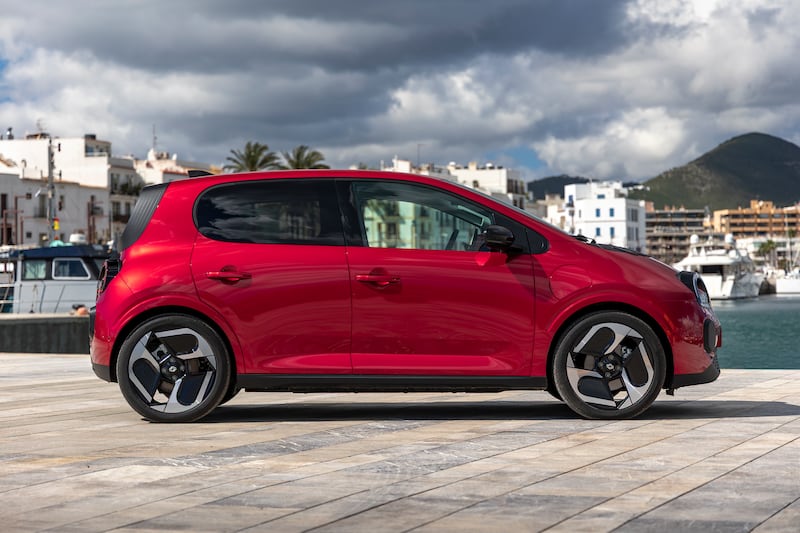
So how is the Twingo likely to fare? The first thing to note about this little Renault is how it looks. They have managed to blend the Twingo looks of old with some new styling touches and tech. The French car still raids the parts bin of its larger siblings, but there are just enough individual touches here to give the car its own character.

The 7-inch touchscreen driver display has the retro-styled graphics, but the 10-inch central multimedia touchscreen is standard-issue Renault. The upside of this is that it supports Google’s infrastructure, which means Apple CarPlay and Android Auto compatibility.
The steering wheel has the usual array of controls, but it’s bigger than it needs to be in a car of this size. The Twingo cabin would look tidier, and the car would probably feel more nimble, if it had a smaller steering wheel.
But the real focus of our interior interest in the Twingo was in the rear seats. Renault sent along a little companion: a cliche-ridden toy frog who sat in the back. Meant to demonstrate the room you have for small children, it did show off the rear space.
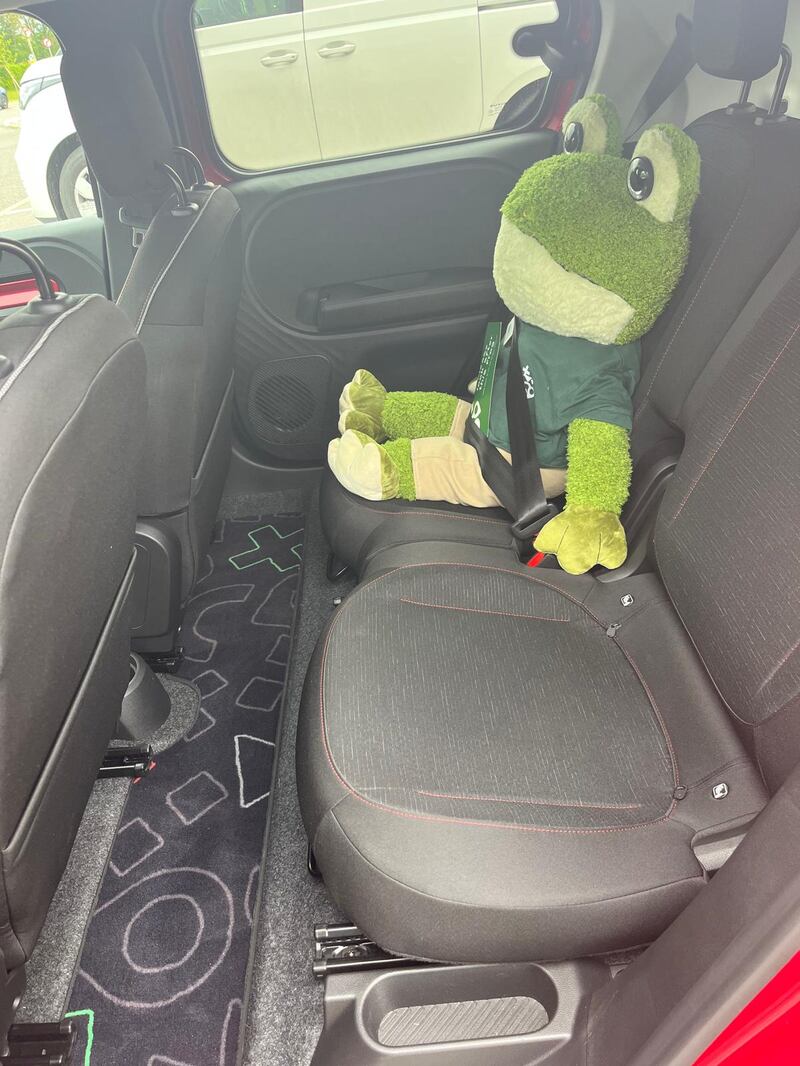
However, it didn’t address the issue we’ve had with both Renault 4 and 5: the tight rear footwell. It’s still an issue for adult feet, but by slightly changing the height of the front seats, it’s not as restrictive as with its siblings.
It’s fair to say that for a city car, these rear seats are pretty practical. It’s a smart move to offer it with just two rear seats rather than the usual bench. In the Renault 5, for example, they squeezed in a tiny middle seat that is utterly impractical and wasted an opportunity to make the usable outer rear seats a little more opulent.
In the Twingo we get the two-seat format, thereby creating broader seats, which can also slide forward and back, so you can decide if you want a little more legroom or a bit more bootspace.
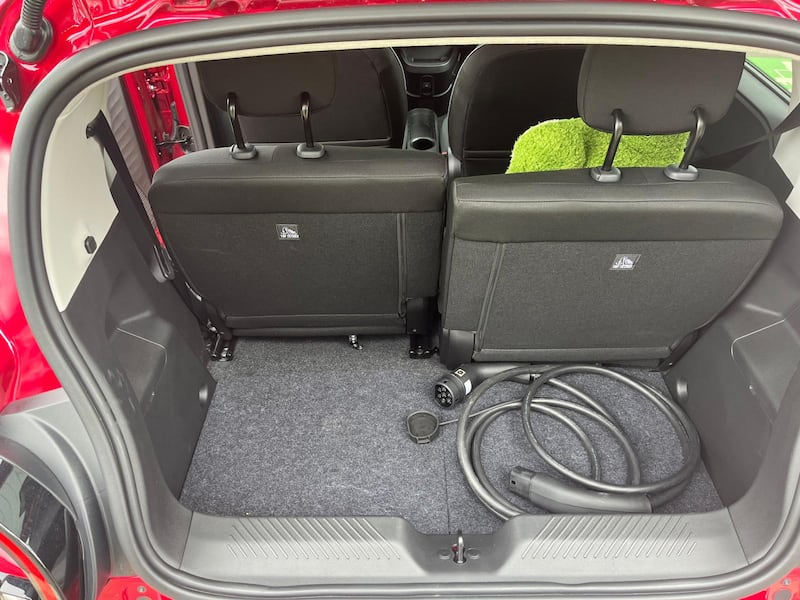
The boot itself can cater for two carry-on cases with the rear seats in situ, while there’s a handy well under the floor to stow the EV charging cables.
Power comes from a 60kW (82hp) electric motor, powered by a 27.5kWh battery pack, which Renault claims delivers a range from a full charge of 263km.
The French car manages this sort of range from such a small battery pack largely thanks to its light weight. The Twingo comes in a 1,124kg, which is between 200kg and 300kg lighter than many rivals. That’s the equivalent of removing two adults and their luggage from the car.
[ Audi’s hybrid Q3 proves we’re focused on the wrong carsOpens in new window ]
And that saving means it can do more with a much smaller battery pack, using less energy while delivering a better drive. Renault has reminded us of something many seem to have forgotten: the secret sauce for EVs isn’t necessarily a bigger battery but rather a lighter one.
While the range estimate is trailing rivals who claim over 300km or more, it does seem an honest estimate based on our time with the car.
After a day’s driving we managed to average 11.3kWh/100km, which for us is something of a record low consumption figure. It’s all the more impressive when you consider that most of our day’s driving was done in England on either the M25 or its national A roads network.
Neither is likely to be the natural habitat for Twingos. It can flit along with the traffic, but it suffers under crosswinds and there is certainly the whistle of wind noise.
Tip the regenerative braking to the max and this car is a doddle to drive in town. Which invariably helps with range.
In its more traditional setting, nipping around the urban and suburban streets of landmark towns like Milton Keynes and Leighton Buzzard, we averaged just 10.5kWh/100km and that was with the climate control working hard to combat the summer heat.

And when we did pull into a charging station – an impressive bespoke EV stop with its own wind turbines and a Starbucks on site – by the time the battery was at 100 per cent charge, the car estimated a range of 255km.
Eking out that sort of range from this relatively small battery means a trade-off in performance. EVs have earned a reputation for delivering supercar acceleration at affordable prices. That’s not the case here. Renault has tempered its acceleration to maximise range, which makes complete sense in this city-car class. A 0-100km/h time of 12.1 seconds means there will not be any Twingos racing away from the traffic lights. In performance terms, it is outgunned by the Inster and it’s likely the VW Group rivals will all outrun it as well.
Steering feel is as light as you’d expect from a little city car, but it keeps the communications flowing to the driver, while there is a nice grip to the brakes, which don’t suffer the sort of spongy initial response we’ve encountered from some small EVs.
Up against its rivals, the Inster still feels more substantial, but the Twingo feels lighter and a bit more playful. That gives it a significant edge over its Chinese rivals both when it comes to steering feel, poise and natural braking feel.
Surprisingly we found the Twingo’s ride to be firm, but it would likely be softer and more comfortable on the regular 16-inch wheels rather than the 18-inch ones fitted to our test car. That said, it’s certainly not something that will put potential buyers off, while it does help
Measuring in at just 3.8 metres, the Twingo’s small footprint makes it a doddle to drive in even the most ridiculously tight city car parks. It’s also impressively easy to manoeuvre, with a turning circle of just 9.87 metres. To put that into perspective, the Renault 5’s is 10.3 metres, and the Hyundai Inster is 10.6 metres. Rattling off these figures may all seem a bit nerdy, but they matter when it comes time to park up.
All of which helps to make the Twingo feel exactly as a city car should: compact, easy to live with and pretty effortless to drive.

Which brings us back to price. For all its cute looks and charm, the Twingo needs to be hitting the market at well under €20,000 if it wants to make its mark on rivals.
For us the benchmark remains the Hyundai Inster and it starts at under €20,000, while the Leapmotor T03 is now priced at under €19,000. That Chinese rival delivers similar range and practicality, though it doesn’t have the Twingo’s charm.
So, Renault has built the right car for the market right now. Now it simply has to find the right price. Start the new EV Twingo priced below €19,000 and it could become one of Ireland’s best-value EVs. Miss that target, and buyers will walk into the showrooms of its Asian rivals.


