

The Kennedy Center is not the most elegant building. White and subtle as an airport hangar, it sits on a perch above the Potomac river next to the Watergate building and neither edifice has changed much in the 50 years since the most famous burglary of the century was committed at the latter.
On Wednesday night, the snow was still piled up on the residential streets around Foggy Bottom. A small crowd hurried across the salted pavilion for the teatime show – on this night, a string quartet running through a series of pop classics.
Inside the Hall of Nations, the red-carpeted interior promenade featuring the flags of many nations and old portraits of John and Jackie Kennedy in the Camelot era, it was warm and the staff, red-jacketed and formal, were unfailingly pleasant.
But beyond the small crowd in for the pop classics in the Eisenhower theatre, the hulking auditorium was empty and felt all the lonelier given the announcement by US president Donald Trump that it is to close, on Independence Day, for two years, to be rebuilt as something else: that he will transform a “tired, broken and dilapidated centre” into “a world-class bastion of arts, music, far better than it has ever been before”.
RM Block


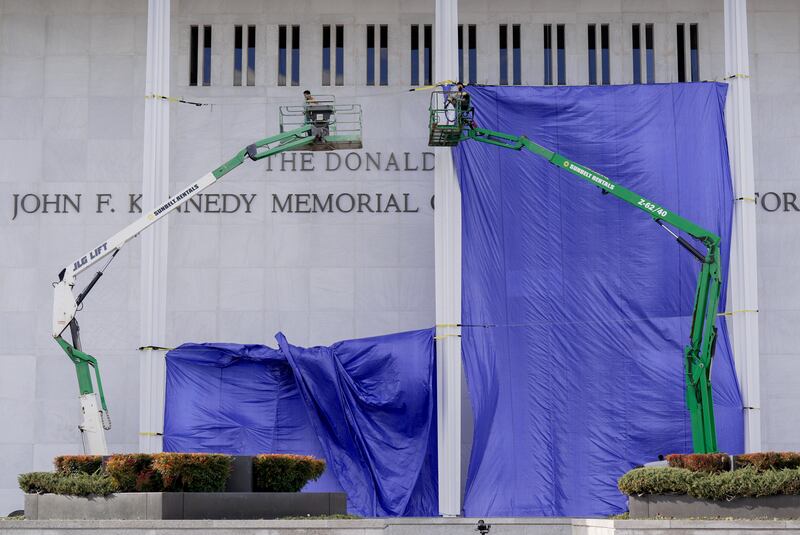
“I’m not ripping it down,” Trump told media in the Oval Office. “I’ll be using the steel. So we’re using the structure.”
Who said he wasn’t sentimental?
Various members of the Kennedy family responded to Trump’s abrupt announcement with a combination of defiance and sorrow. The July 4th closure will go ahead “pending board approval”.
But given that Trump fired the previous board in its entirety shortly after his inauguration and appointed himself chair, that isn’t likely to be a problem.
[ From battleships to buildings: Trump’s name is everywhereOpens in new window ]
Joe Kennedy III, the former congressman for Massachusetts and grandnephew of JFK, noted that the centre was named after the slain president as “a living memorial to him, as a place built by the people for the people to celebrate what connects us”.
“While this trespass on the people’s will is painful,” he continued, “president Kennedy would remind us that it is not buildings that define the greatness of a nation. It is the actions of its people and its leaders.”
That observation touches on the motivation – and underlying anxiety – behind Trump’s architectural reimagining of Washington. The city is a place of grand edifices and statues and tributes to the long dead. Everything feels slightly too big, as though it was designed on a scale to exhaust the legions of summer tourists who pay pilgrimage along the national mall. Past presidential names grace memorials, libraries, federal buildings and the airport.
As a 79-year-old second term president, Trump is thinking about legacy. If and when he leaves Washington, he wishes to leave an indelible mark.
First, he paved over the Rose Garden. The shock demolition of the East Wing to facilitate the construction of a fabulous ballroom of gold and marble represents a clearer indication of the president’s intention to leave behind a White House reimagined and reconfigured to his taste and image.

On Wednesday, new renderings of the proposed $300 million (€254 million) ballroom were released, depicting a new wing designed to complement the executive mansion. Historians and architects fear that the scale of the ballroom will distort the aesthetics and overwhelm the residential mansion: that from above the building would resemble a lobster with one enormous claw.
Trump has also said he now wants a planned commemorative arch to be “the world’s biggest”, to be constructed near the Arlington Memorial bridge, near the Lincoln Memorial. At 250ft in height, it would, naturally, eclipse the Lincoln’s doric temple, which serves as a perfect viewing point along the mall.
“The experts who think it’s too big are used to living with things being small,” Stephen Cheung, White House communications director retorted on Sunday.
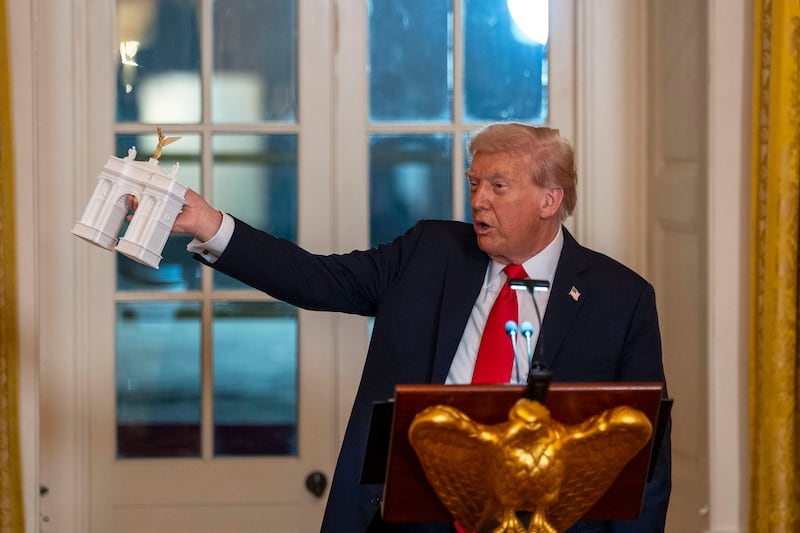

Trump’s announcement that the Kennedy Center is to close its doors drew instant analysis that the decision was designed to save face in the wake of plummeting ticket sales and high-profile performance cancellations by artists ranging from Béla Fleck to Philip Glass.
The one occasion when the Kennedy Center did draw international attention was for the jaw-dropping performance given by Fifa president Gianni Infantino throughout the World Cup draw on a snowy December Friday, culminating in the association’s “peace prize” gifted to Trump. Given the imminent closure, Infantino’s turn on the stage could go down as the defining moment of the Kennedy Center in Trump’s second term.
[ Trump, Infantino and the YMCA: World Cup draw at once unwatchable and mesmerisingOpens in new window ]
The president’s designs on claiming the performance landmark became louder through his first year, when he began teasingly adding his own name when referencing the Kennedy Center in social media posts. The administration’s war on DEI (diversity, equity and inclusion) meant the end to performers deemed “woke” and a programme reflecting the president’s own tastes – Broadway and West End musical standards – began to crowd the calendar.
It was a direct repudiation of the mandarin or rarefied tastes of the benefactors and patrons of the Kennedy Center. But it ignored the fact that mainstream acts are available in the main sports arena downtown. So people stopped coming.
“First he put his name on it, and he has attacked and besmirched people who were involved in dedicating their careers to the Kennedy Center,” Barbara Comstock, the former Virginia Republican congresswoman and Kennedy Center board member, told NPR recently.
“So he makes it about himself. And now, because it’s been a failure, because people have left and not wanted to be involved with it now because of what he has done, he’s shutting it down and now we have to worry about what he might do. Will he try and destroy the building itself, like he has the East Wing?
“We can’t trust that he will do anything legal, because there’s an open case right now challenging what he has done on putting his name on it. The way he has removed board members, certainly, we don’t think it is legal. And he hasn’t involved Congress in this, which provides funding, and we don’t see that leadership in Congress will step up and challenge him.”
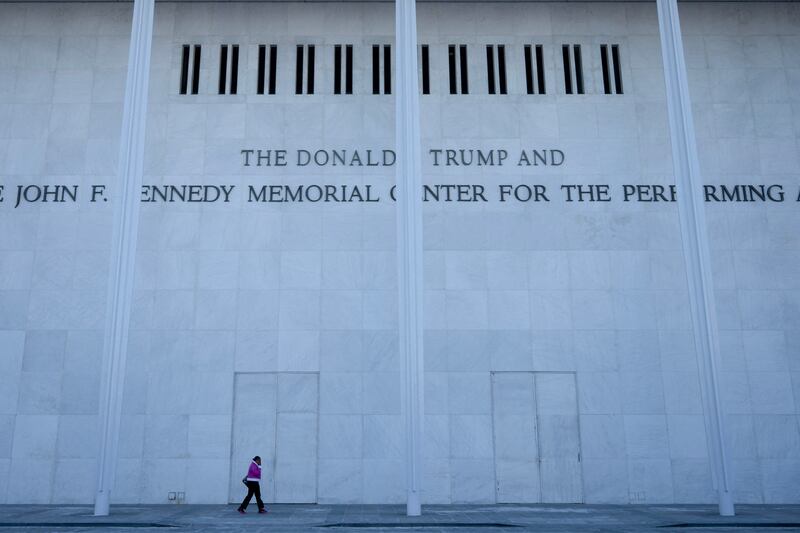
As recently as December, Trump claimed that improvement work had “saved the building” which had been in “bad shape, both physically, financially and every other way”.
Now, it will go dark with no clear idea as to how the replacement building will look – or what it will be called. That the Trump name will adorn the new building is a certainty. But whether the Kennedy name will remain is less clear.
[ Sinéad O'Sullivan: Why is Ireland so lacking in architectural ambition?Opens in new window ]
The resistance to Trump’s grand designs on Washington’s landmarks is part of an old tradition. Plans for a memorial befitting Lincoln were pondered and shelved for five decades after his death before ground was broken and at the time many felt that Henry Bacon’s ornate Greek temple was too extravagant to truly reflect the simple tastes and life story of the president. It is now the most visited landmark in the entire National Parks domain. Similarly, Roosevelt’s addition of a west wing to the White House provoked strong criticism from the Washington Post, which argued that it “destroyed historical value”.
But the imminent and abrupt closure of the Kennedy Center places a question mark over a building that some regarded as the national theatre of the United States. The national symphony orchestra, which has performed there since 1971 and plays up to 150 concerts a year, learned of the plan when Trump announced it on Sunday night. Their schedules and contracts are fixed years in advance: all of that has been thrown into turmoil. So, too, has the employment of staff members. Democrats have complained that the closure announcement is unlawful and dispatched a letter to the Oval Office stating as much.
It remains to be seen whether the excessive and gold-heavy aesthetics with which Trump has redecorated the White House will dominate the future buildings that will serve as his legacy.
The motivation for all of this is obvious. Irrespective of how future historians interpret his two-term presidency, the buildings and arch can serve as lasting physical proof of Trump’s time in the White House, which “they” cannot erase or distort – or tear down. Although, as he has already demonstrated since returning to Washington, they absolutely can.


