The ideal life, as Iran’s slain supreme leader put it in late 2024, was one in which a person would get an education, become “useful for Islam”, live into their 80s or 90s and then become a martyr.
A little over a year later, the 86-year-old Ayatollah Ali Khamenei met that fate, killed this February in the opening salvo of the US-Israeli war on Iran – a death his supporters framed as the fulfilment of his revolutionary narrative.
Khamenei will be buried on Thursday in the Iranian holy city Mashhad, his birthplace, in a ceremony that will mark more than just the culmination of his days-long funeral.
It will also signal the symbolic end of a nearly 37-year era in which Khamenei was the towering figure who shaped and held together the Islamic republic.
RM Block


He remade institutions from Shia religious groups to the Islamic Revolutionary Guard Corps (IRGC), promoted militant proxies across the region and suppressed waves of popular dissent at home that in his latter years increasingly led to him becoming a lightning rod for anger against the regime.
His son and successor, Mojtaba Khamenei, will now take over a country battered by the war and wracked by economic dysfunction.
Yet little is known about how Mojtaba – who has not been seen since his appointment in March – plans to rule. Lacking his father’s revolutionary credentials and decades of authority, analysts and officials expect a system in which institutions such as the IRGC play a larger role, even as Mojtaba remains the ultimate decision maker.

The question is whether that model will be enough for the regime to endure. One insider argued it had reached the point where even Khamenei “could no longer fix the country’s problems, because domestic and foreign challenges had become too complicated”.
“Now,” the insider continued, “his son is better positioned to open a new chapter ... with the support of powerful institutions”.
The IRGC, under new commander Ahmad Vahidi, has influence over security, foreign policy and large parts of the economy and has become even more empowered during the war.
Mojtaba is also expected to rely on religious organisations that mobilise supporters during periods of crisis, wealthy patronage networks and regional proxies such as Hizbullah in Lebanon – though they too have been weakened.
“The networks built under Ali Khamenei helped the state survive the war,” said Saeed Laylaz, an Iranian analyst. “Now, Mojtaba Khamenei will have the final say in all major decisions, but institutions will play an even greater role than before.”
Even before the conflict the regime had been in crisis. Years of sanctions, international isolation and economic stagnation culminated in mass anti-regime protests in January, brought to an end by a brutal crackdown in which thousands were killed. The violence further eroded the republic’s diminishing legitimacy in the months before Khamenei’s death.
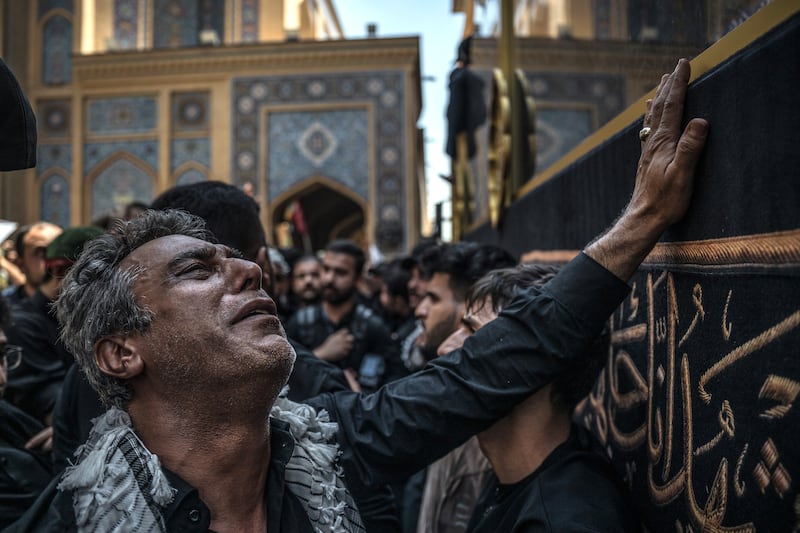
The Islamic republic has, however, sought to turn the six-day funeral – during which Khamenei’s coffin was transported across Iran and into neighbouring Iraq – into a show of defiance, presenting the massive turnout as evidence that it not only survived the war but retained a committed, loyal base.
It also served as an opportunity for the regime’s new leadership to appear in public after months in hiding.
Vahidi, whose predecessor as the IRGC commander was killed during the conflict, was seen publicly for the first time since the war last week by Khamenei’s coffin.
Parliamentary speaker Mohammad Bagher Ghalibaf, who emerged as one of Iran’s most powerful wartime leaders, also appeared with president Masoud Pezeshkian and judiciary chief Gholam-Hossein Mohseni-Ejei, among others.
Even former president Mahmoud Ahmadi-Nejad, who has fallen out with the regime – and whose neighbourhood was bombed in an incident that killed several of his bodyguards – appeared following months of speculation about his fate.
Mojtaba, however, was nowhere to be seen and has not released any video or audio messages since taking power. Even before becoming supreme leader, he rarely appeared in public. Regime politicians, officials and some foreign diplomats insist that his four-month absence is for security reasons and he remains in control.
They say he has recovered from wounds sustained in the strikes that killed his father, wife, sister, brother-in-law and 14-month-old niece, all of whom will also be buried in Mashhad.
Yet Mojtaba’s absence has sparked speculation about his whereabouts from some Iranians accustomed to regular speeches from the elder Khamenei, whose public communication was central to his rule.

Mojtaba’s first big decision suggested a cautious approach. Last month, he authorised Pezeshkian to sign a memorandum of understanding to reopen the Strait of Hormuz – Iran’s newfound source of leverage – and begin negotiations with the US over a deal to end the war, all while distancing himself from the agreement.
Although Mojtaba in a written statement had said he opposed the deal “in principle”, the supreme leader said he allowed it to go ahead because it had been approved by the Supreme National Security Council, which includes senior Iranian military commanders and is chaired by the president.
His statement also made clear that responsibility for delivering the agreement’s economic benefits, including securing the release of frozen Iranian assets, rested with Pezeshkian.
The episode suggested Mojtaba was trying to continue the balancing act his father had long used to manage rival factions within the regime.
On the one hand, he has given space to pragmatists such as Ghalibaf, who see a deal with the US as the only way to secure sanctions relief and alleviate economic pressure.
“Ghalibaf is now the new leader’s right hand,” said the regime insider. “He understands that his first priority is the country’s development and he will prove to be a pragmatist.”
That approach, however, faces fierce resistance from within the regime’s base, who see negotiations with Washington as anathema to their ideology and Khamenei’s legacy.
[ No strait answer as US and Iran are stuck in cycle of strikesOpens in new window ]
Many in the vast crowds who attended the funeral carried banners calling for retaliation and chanted “Death to America”, directing anger at officials leading the talks.
“I cannot believe negotiators are trampling on our leader’s blood and negotiating with the US,” said Mahnaz, a 35-year-old primary schoolteacher who attended a funeral procession in Tehran.
Yet relying too heavily on this hardline base risks further alienating large segments of Iranian society, including an urban middle class and increasingly secular young population who want an end to the regime’s religious restrictions and more engagement with the world.
Some within the system argue that too many concessions risk emboldening the many Iranians who loathe the regime, and a return of the sorts of protests that rocked the country in January.
“In the new chapter, the supreme leader will show less tolerance towards anti-regime forces at home,” said Hamid-Reza Taraghi, a hardline politician in Mashhad. “The institutions, led by the Revolutionary Guards ... will help the new leader exercise greater control over state affairs. He will bring younger generations into the system who are willing to take risks.”
One former senior reformist official said he believed Iran “will become more closed politically while becoming more open on social issues. It is hard to see the Islamic republic changing dramatically”.
Mojtaba has signalled continuity, reappointing the hardline judiciary chief Mohseni-Ejei for another five-year term.
But many observers believe the defining test will be whether Tehran can reach a durable agreement with Washington in the coming months, something that would involve Iran making significant concessions over its nuclear programme.
[ Trump says Iran ceasefire is ‘over’. But is it?Opens in new window ]
That could provide an opportunity for the new supreme leader to start adapting his father’s legacy. Yet reaching such a deal faces enormous obstacles.
The US and Iran have exchanged tit-for-tat air strikes this week after Washington accused Tehran of attacking commercial shipping in the Strait of Hormuz, which Iran insists it must control as part of any deal. That prompted US president Donald Trump to say he thought the ceasefire was “over” – even before complex nuclear negotiations had begun in earnest.
Mohammad Sadegh Javadi-Hesar, a reformist politician in Mashhad, said that while he thought Mojtaba might make some changes in domestic policy, the regime would become more emboldened internationally.
“Some policies, particularly those related to the region and the Persian Gulf, may become even stronger,” he said. “Iran is no longer afraid of fighting a war.” – Copyright The Financial Times Limited 2026