Sometimes, you just want a car. Along with the electric car revolution (which is, don’t get us wrong, a good thing) car makers have taken the opportunity to try to give their products some of the same appeal as our mobile phones, tablets and laptops. Every car company, at some point or another, has said it wants to be considered a tech brand that just happens to make things with wheels. Cars have sprouted massive touchscreens (sometimes more than one at a time), full-width displays, digital cameras instead of mirrors (best avoided – they’re really not worth the hassle), and the ability to use your phone as the key thanks to NFC technology.
Sometimes, though, you just want a car. You just want to be able to sit in, switch on and drive off, maybe even changing gears for yourself, without having to plan charging stops, nor go through a whole series of on-screen menus to silence the beeps and bongs before departing the kerbside.
The good news is that you can still buy cars like that. The bad news is that, a) many of them are wildly expensive and, b) of the ones you can actually afford, they’re not going to be around for much longer, so you’d better get your skates on.
While electric cars have stolen the headlines this year, becoming for the first time ever the most popular choice of “fuel” among Irish car buyers – leaving petrol, diesel, and hybrid behind – there has been a much bigger change happening in the background. The manual gearbox is dying, with only 35 per cent of Irish new car buyers, so far in 2026, choosing a gearbox controlled by human hand.
RM Block


Ireland is not alone in that respect. In the UK, there are now proposals to phase out manual gearbox driving instruction unless someone specifically seeks it out. Obviously, electric cars have played their part in this – there are currently no EVs with a manual box – but it’s broader than just that. Car makers have phased out manuals because automatic gearboxes are now smart enough to be able to trim a car’s CO2 emissions, and equally, it’s cheaper to just build a car with one gearbox, rather than a choice of two, and so manuals are on the way out.
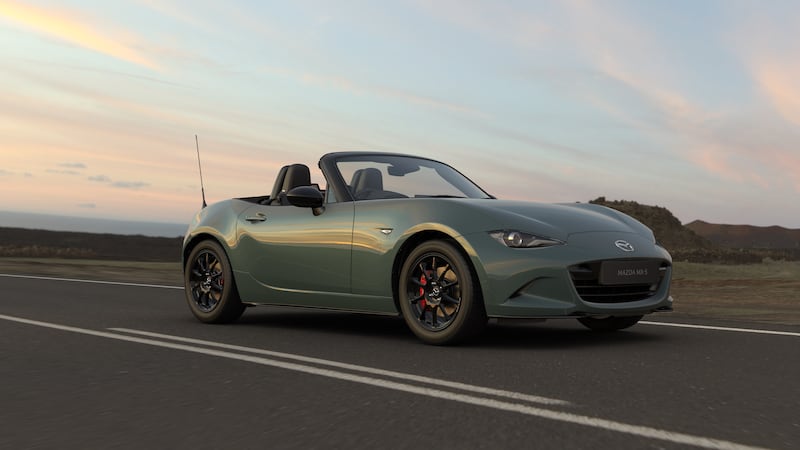
On the way out, but not quite dead yet. You can still buy a Mazda MX-5 sports car, for instance, and you really should if you can. It remains one of the very best cars you can drive, it’s not over-priced, it’s frugal, and it comes with both a small dashboard touchscreen and a manual gearbox that feels so perfectly machined and precise that you half expect to find a Rolex label on the gear lever. You don’t have to go for a two-seat sports car either – the same basic gearbox features in the likes of the Mazda 3 hatchback and saloon, and the Mazda CX-30 crossover, both of which come highly recommended in both the driving pleasure and simplicity stakes.
Elsewhere, the manual gearbox clings on. Skoda still offers the Octavia saloon, in its basic 1.5 TSI form, with a manual as well, while the smaller Kamiq, Scala, and Fabia all also come with “proper” gearboxes. In fact, the basic 95hp Kamiq and Scala actually come with a mere five-speed manual, if you really want to recreate that 1990s feel. Thankfully, those three smaller cars also have smaller, simpler touchscreens too, which makes life on board feel rather wonderfully less complicated.

You can also still buy the Seat Ibiza, Arona, and Leon with a manual transmission, while the Volkswagen Polo, Golf, and T-Cross are all still manual-equipped in basic form. Audi is pretty much the last holdout of the manual gearbox in the premium-badge market, with the basic version of the little A1 hatchback still available with a self-shifter, as is the A3 hatchback and saloon. If you go looking for a manual ‘box with Audi’s rivals over at BMW and Mercedes, you’ll be left disappointed.
Opel, Peugeot, Citroen, Fiat, Jeep, Dacia, Ford, Hyundai, Kia, Renault, Suzuki, and Toyota also all still offer at least one model with a manual, but the available choice really is either narrowing down to bargain-bucket basic models or, as in the case of Toyota, wild and expensive enthusiasts’ cars such as the high-performance GR Yaris (another car, like the Mazda MX-5, that totally nails the brilliant, polished, mechanical feel of a great manual gearshift).
In a few years, even these might be gone, as the mainstream of motoring leaves the manual gearbox behind altogether. Or will it? Actually, there are some rumblings that the human-controlled gearbox might not be quite dead after all.

At the highest possible level, it’s definitely not. McLaren has just shown off the McL6 GT, a superfast supercar, with a multimillion euro price tag, that has at its heart a traditional six-speed manual gearbox, complete with an exposed shift mechanism in the cabin so you can see all the delicate linkages at work. Ferrari, having given up on its traditional “open gate” manual boxes more than a decade ago, is now kind of bringing them back, offering its 12Cilindri V12 grand tourer with an odd gearbox that’s technically an automatic, but which can be shifted manually through one of those traditional “clack-clack” shifters if you like.
Back at a more potentially affordable level, Toyota says that it’s working on a manual gearbox that will work with future electric cars, bringing back a level of entertaining tactility to a type of car that so far, for the most part, hasn’t technically had a gearbox at all – electric cars usually just have a single reduction gear, which slows down the wild spinning of an electric motor to a speed that’s compatible with tyres and tarmac.
Actually, we’ve driven an electric car with a manual gearbox. A few years ago, Opel showed off a concept car called the Manta GSe ElektroMOD. That car used a modern set of batteries and an electric motor but built them into the restored body of a classic 1960s Opel Manta coupe, which oddly kept its original four-speed manual gearbox. It was a strange sensation, as you could just leave it in any gear you wanted and drive it like a modern EV, or you could shift gears yourself, at a whim, making the driving experience more engaging.
And that, it seems, is the trick to all this, and the reason why car makers have still not quite abandoned the idea of manual gearboxes. While electric car sales are growing fast, there is still a strong sense that they’ve not been designed for fun. Quite the opposite – electric cars are sold on their combo of silent running and frugal cost base. But car makers know that car enthusiasts – petrolheads if you prefer – are also opinion-makers, and if at least some EVs can be turned into something rather more fun and enjoyable, then more happy vibes might be in the air regarding battery power, which might convince a few more people to make the switch sooner. Equally, with car ownership as a basic concept under pressure from legislators and environmental advocates, car companies are scrambling for reasons to actually buy and own a car, knowing that few, if any, car purchases are truly rational.
Of course, you could go completely the other way. Recently we drove a tiny Morgan Super 3 sports car, which not only doesn’t have any hybrid assistance, it also doesn’t have power steering. Or a touchscreen. Or even a windscreen or a roof. It’s even lacking a fourth wheel, but it’s one of the most spectacularly enjoyable cars we’ve driven in years. There’s a lesson in there somewhere – you can try to turn a car into an oversized mobile phone all you like, but for fun, enjoyment, and engagement there’s no substitute for simplicity.