

In May, Minister for Climate, Energy and the Environment Darragh O’Brien launched the Offshore Wind Energy Programme report, outlining advancement in offshore energy delivery.
The report revealed that planning applications for all five phase-one projects in development off the east coast have been lodged with An Coimisiún Pleanála, kick-starting the bid to turn Ireland into what some have called “the Saudi Arabia of offshore wind power”.
Certainly, the potential is there. “Ireland has no shortage of wind. What we have lacked until now is a way of harnessing that resource at the scale needed to transform our energy system,” says David Cashman, business consulting partner at EY Ireland.
“That is why offshore wind has become such an important national priority. With planning applications now submitted for the first wave of offshore wind projects off the east coast, Ireland is closer than ever to turning one of its greatest natural advantages into a major economic and environmental asset.
RM Block



But the road ahead is not straightforward. “Even if projects receive planning approval they still need grid connections, ports, supply chains and years of construction work before electricity starts flowing,” he says.
Grid buildout is an enormous challenge. “Ireland’s binding constraint is not generation capacity, it is offtake. Without interconnection, industrial load or data centre demand co-located with the resource, Ireland runs the risk of gigawatts of stranded capacity.”
While the need to move away from fossil fuels is the primary driver, a new one has hoved into view – the need for energy security in a world increasingly prone to geopolitical shocks.
“The more energy we produce ourselves, the less exposed we become to events beyond our control. That means a more secure and resilient energy system,” says Cashman.
It’s why offshore wind is about much more than simply lowering electricity prices.
“No energy source can guarantee cheap power all of the time. However, offshore wind can help protect consumers from extreme fossil-fuel price shocks. In a world where energy security has become a major strategic issue, that stability has real value.”

The most significant challenges in relation to developing offshore wind remain the planning system and grid consenting and investment timelines, says James Delahunt, partner, corporate finance, and head of energy and natural resources at KPMG.
“While there has been positive headline policy support which is welcome and has helped stimulate interest in the sector, in order to move from an ambition to delivery stage the overall timelines for planning permission consent and grid consent and investment will be the key determinants to the timeline for projects to be in a position to deliver,” he says.
“In addition to this, as a country Ireland needs to ensure that it has the supply chain and infrastructure – including port infrastructure – to ensure that projects can both be delivered but also at a cost that is economic for developers to ensure the long-term cost of electricity produced by the projects is competitive and affordable.”
To accelerate offshore wind development, Delahunt believes streamlining regulatory processes is crucial. “A dedicated taskforce to co-ordinate delivery across both offshore and onshore renewables is essential and a mobilisation of Government and industry stakeholders is required to extend Ireland’s renewables ecosystem, much of which is already operating at capacity,” he says.
“Enhancing grid infrastructure, investing in R&D for technologies like floating wind, and building stronger partnerships between Government, industry and local communities will all be vital for swift advancement.”
Failure to embrace offshore wind could result in substantial missed opportunities for Ireland, says Delahunt, not least because having a resilient energy system is critical to economic growth through allowing indigenous business to invest and scale, and attracting foreign direct investment.
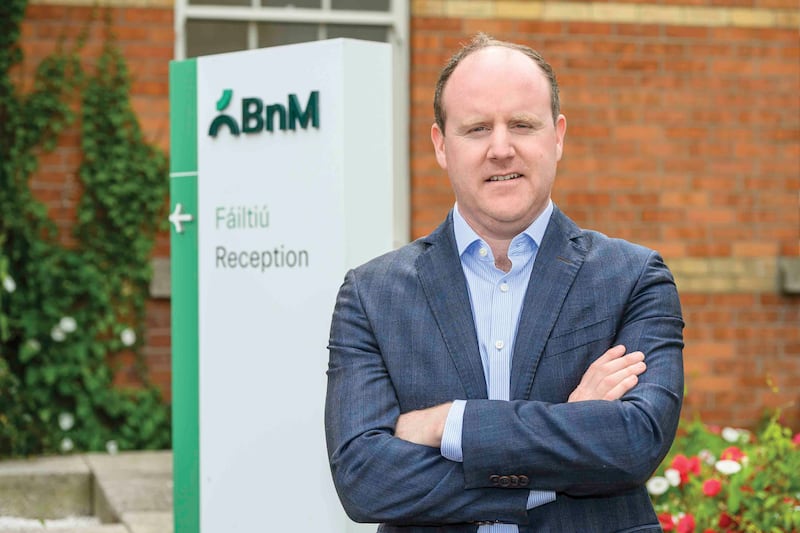
“In the near term, the east coast is likely to provide the first major opportunity to scale offshore wind, given its suitability for fixed-bottom turbine technology and the progress already being made by Phase One projects,” says Brendan Kelly, head of commercial at BnM, formerly Bord na Móna.
The company has been involved in the offshore wind sector for a number of years and, through its partnership with Ocean Winds, sees strong long-term potential for offshore as part of Ireland’s future energy mix, which also includes onshore wind, solar, battery storage, biomass and flexible backup capacity.
It is important, however, to view offshore in the context of timing, he points out: “Offshore wind will be a significant part of Ireland’s longer-term energy future, but onshore wind, solar, storage and flexible capacity will continue to do much of the heavy lifting in the near and medium term.”
This is consistent with BnM’s wider strategy. “Through our Energy Parks initiative we are focused on bringing renewable generation, storage, grid infrastructure and major energy demand together in the right locations, turning clean energy potential into long-term economic value,” he says.
Offshore wind projects are large, complex infrastructure developments requiring planning consent, grid connection, port capacity, supply chain readiness, financing and clear routes to market.
Such barriers should not be seen as reasons to question the opportunity, he says: “They are the practical realities of building a new industry at scale. The priority now is co-ordination across planning, grid, ports, supply chains, investment and demand.”
Ireland has the same significant wind resource onshore, along with existing supply chains, delivery experience and an installed base that is already making a big contribution to the electricity system.
“BnM’s land bank gives us a distinctive role in this. We have an 80,000-hectare land bank, deep roots in the Midlands and a proven delivery record. We have already developed a clean energy portfolio of approximately 1GW and are advancing a 6.5GW pipeline across onshore wind, offshore wind, solar, battery storage, biomass and flexible backup capacity,” says Kelly. “That balanced portfolio is central to how we see Ireland’s energy transition”


