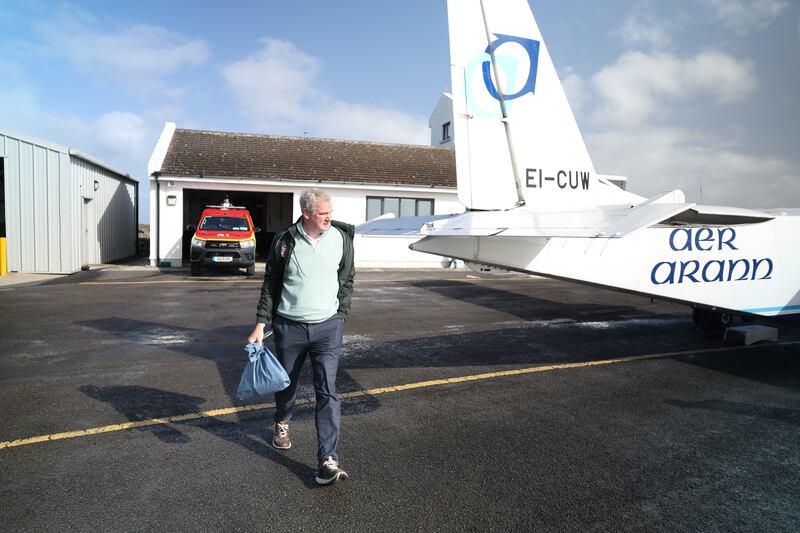
Carrying just seven passengers on Wednesday morning, the Aer Arann twin-prop Islander plane takes flight from Minne Airport in south Connemara to make the seven-minute journey to Inis Oírr.
With a stiff northeasterly wind, the plane makes its approach from the south, descending to a tiny airport set among the karst limestone, sandy dunes and hardy vegetation of this treeless, windswept island home to 300 people.
And thus begins one of the more unusual canvasses of any Irish election.
Aboard is Seán Kyne, Fine Gael Senator and a candidate in the Galway West byelection that takes place later this month.
RM Block


Leaving the airport, Kyne’s tall lean frame strides purposefully towards the port. Visible is what looks like a North Sea oil rig just off the quay, complete with a tall derrick. It is the platform to construct a new quay for the island, which is the most southerly of the Aran Islands.
Divers working on the foundations come into shore after a long shift underwater. The work will take two more years and cost €36 million.
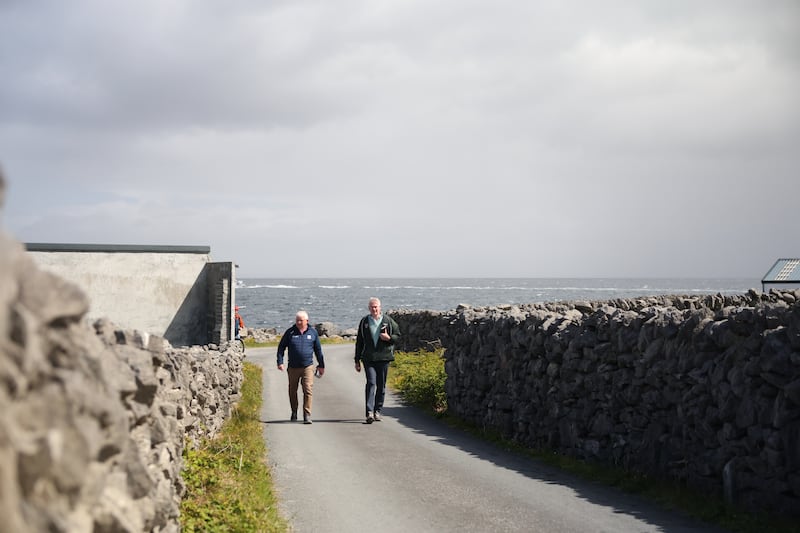
Of the Government “gaiscí” (heroics) Kyne will list today, this project is the biggest. Nearly everybody mentions it. Kyne has a team of personable Connemara canvassers, including popular Inverin councillor Pádraig Mac an Iomaire and brothers Joe and Pádraig Ó Laoi. The team follows the boreens and the stone walls to the houses clustered along the leeside of the island.
It is a raw day with a big wind. The sea is choppy. “Tá corr ar an bhfarraige (There is a stir on the sea),” says one islander.
“Tá breeze maith ann all right (There is a good breeze there all right),” replies Mac an Iomaire, in an understated way. Despite the bad weather, there is a fair smattering of day-trippers over from the ferries from Doolin.
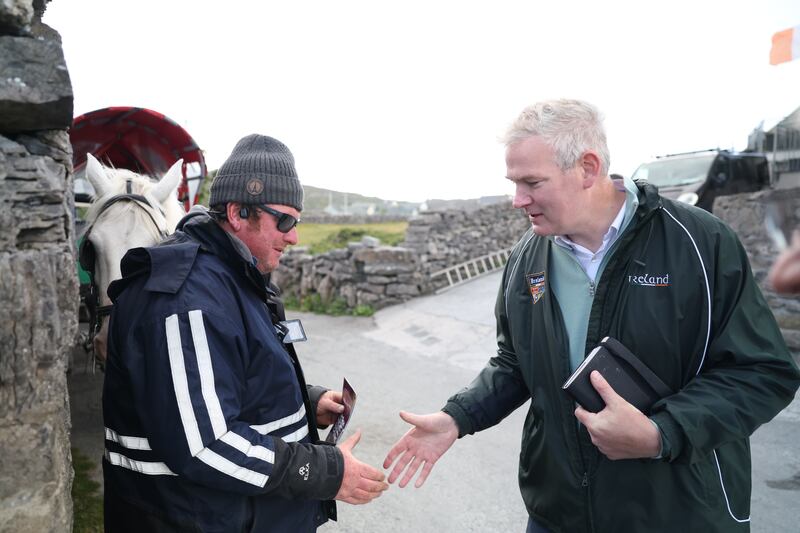
The canvass takes place wholly in Irish. Kyne, who is from Maigh Cuillinn, is comfortable speaking the language. Tomás Ó Conghaile, standing outside his house, says “everything is a struggle on the island”.
He nods at the construction at the port with approval. “Is céim mhór mhíllteach é mar go raibh sé ag teastáil le sabháilteach (It is a huge step because it was needed for safety reasons),” he adds.
The theme of struggle is also taken up by Máirtín Ó Domhnaill, who is doing up an old house. He says that whatever price he pays for aggregate in Galway it ends up costing twice that much to take it on to the island.
There are 2,300 people living on Ireland’s bigger 11 inhabited islands. This is only 0.05 per cent of the population. This tiny cohort are custodians of the national language and a heritage extending back countless generations.
The islands are vulnerable to population decline. The age profile is much older than the mainland, with the largest cohort aged between 60 and 69. Incomes on islands are 60 per cent of the average on the mainland. It is hard to retain a population let alone entice new families.


Meeting Kyne to discuss the issues is Máire Uí Mhaoláin, chief executive of Comhar na nOiléan, a Leader (Government-supported, community-led) company that represents the inhabited islands off the coast.
Uí Mhaoláin shares one piece of good news for Inis Óirr; 33 children are now attending the primary school. That magic figure guarantees a future population here.
She tells Kyne employment is not a significant issue because it is a tourist destination. The struggles lie elsewhere.
It is 30 per cent more expensive to live on an island than on the mainland. Comhar has called for a special lower tax for islanders as an “equalling up” measure. They cannot afford to let populations slip any more, she says.
Before he retired, Fianna Fáil’s Éamon Ó Cuív hoovered up votes on the Aran Islands. Since then, it has been the Irish speakers, including Kyne, who have most benefited.
Úi Mhaoláin believes having Irish is a crucial trait for politicians. “I think you can’t really understand a community that lives through the Irish language on a daily basis if you’re not speaking it yourself,” she says.
In the eastern Galway city suburb of Old Mervue, Sinn Féin candidate Mark Lohan and a team that includes sitting TD Mairéad Farrell and MEP Kathleen Funchion are canvassing on a serene May evening. The tranquil estate was built in the 1950s and is now home to a mix of long-time residents and new families who have moved in and done impressive modernisations of their homes.
A lot of people who moved here and to nearby Renmore were from Connemara and the connections are still strong. Next door is St James’s GAA Club, home club of Galway GAA megastar Paul Conroy, a Gaeilgeoir whose parents hailed from Connemara.
Cost of living is the recurrent theme. At a doorstep, a woman says the weekly shop has become really expensive over the past year.
“You’re so used to buying the same things, and you go: ‘Oh my God’, when you see what they are charging at the till. You’re coming out with half the groceries you had a year ago for the same price.”
Lohan talks about his party’s proposal for a mini-budget: “The Government has €9 billion in reserve, and we want to spend a bit of that on an emergency budget. It’s only a Sinn Féin TD [who] can put that pressure on them. That’s what we want to do, give people a break.”
A woman at another house recounts her encounter that day with a group of teenagers on electric scramblers speeding through the neighbourhood. She is one of several who call for speed bumps on the road.
“Five of them went down the road, one of them was in the middle of the road. They nearly hit my car. I beeped the horn. They just gave me the middle finger,” she says.
At another doorstep, Gary Fay, who works in this area, talks authoritatively about the need for funding and services for children with disabilities.
“We talk to so many people whose kids need places and schools,” says Lohan. It is not that the Government does not have the money, he argues. He refers to the €9 billion in reserve and to the spending of €127,000 on a hospital bike shed in Tralee, Co Kerry.
The Irish Times/TG4 Ipsos B&A poll figures showed Lohan coming in joint sixth place, with 7 per cent support. If that happened on polling day, it would be a crushing blow for the party.
He is trailing behind the other left candidates: Labour’s Helen Ogbu (at 12 per cent) and Míde Nic Fhionnlaoich from the Social Democrats (9 per cent).
He suggests the poll does not reflect where he is in the race.
“I do believe I’m going to finish ahead of colleagues on the left and that those transfers then will put us in position to win this election,” he says.
“I think that Independent Ireland’s Noel Thomas doesn’t have the traction that the media were saying he had initially ... I think it’s going to come down to Seán Kyne and myself,” he says.
Lohan is a trade unionist from Cork. He lived in Boston for many years, becoming involved in local unions and as a Noraid and Sinn Féin activist.
A former councillor, but co-option, he has yet to win an election. If the poll is correct, he will have to wait.
He has been criticised for his lack of Irish. Ironically, he is one of the few candidates who has gone to the trouble of making the journey out to Inis Oírr where, he says, he was well received.