
We have seen insects like these in and around the house. We actually caught a number of in the house. Should we be worried? Mark Averill
I would say it is the insects that should be worried not yourselves. These are ground beetles, Lagria hirta. They have hairy bodies and the adults feed on nectar and pollen. They want to be outside, not stuck in your house. They have wings and can fly, most commonly in the evening when they are attracted to lights. So, if you don’t want them in the house keep the windows closed when you have the lights on. The garden is their natural habitat.
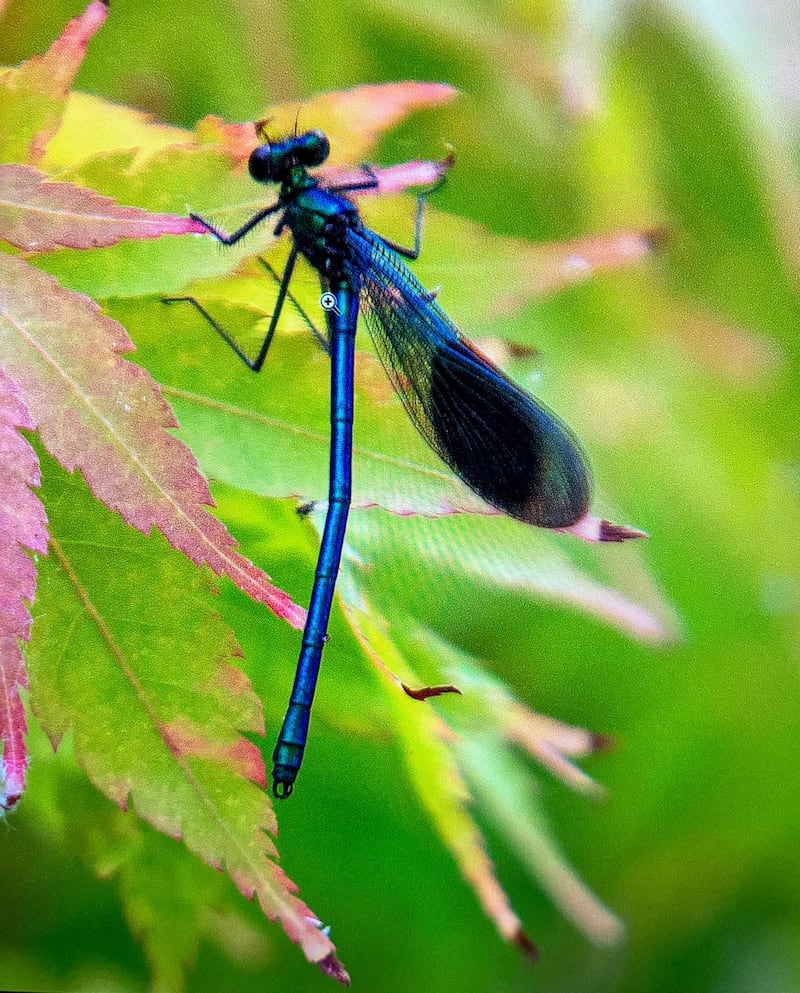
I photographed this lovely damselfly in my garden at the end of July. There is no garden pond anywhere nearby and the nearest river is about a kilometre away. Ciaran Maloney, Pollbrock, Co Louth
This is a male banded demoiselle damselfly. Only the males have this wonderful metallic blue green colour and the blue-black bands along the outer parts of the wings. Females have a metallic green body and translucent pale green wings. The females stay away from water unless looking for a mate, but that doesn’t prevent the males coming looking for them. The eggs are laid after mating in slow moving streams and rivers, so your visitor was looking for a mate rather than a garden pond.
RM Block


While paddling on Lough Derg (Co Clare) recently, I came across some interesting animals and plants – water mint, lilies, mussels, otters and so on. And also, this plant. Is it an arrowhead? Mike Cleary
These species are all part of the biodiversity of the shoreline of a freshwater lake. The plant you sent the image of is an arrowhead – Sagittaria sagittifolia. While its roots grow in shallow water, most of the arrow-shaped leaves are borne above the surface on long stalks. There are only three petals on each flower. It is a rare plant, growing at the edge of lakes and slow-moving waters mainly in the centre and east of Ireland. Lough Derg is one of its known habitats.

I attach a photo of a moth that was attached to a west-facing wall. It’s green/blue, about an inch wide. I’d be grateful for an identification. I’ve never seen one before. I looked up moths in Collins Irish wildlife guide. The nearest I could see there was a large emerald moth, although the colour there is a lighter green. Maryrose Bogan, Killorglin, Co Kerry
You nearly have it right. It is an emerald moth, not the large emerald, but the grass emerald, a smaller blue-green moth. We have five emerald species of moths in Ireland, four of them quite common. The caterpillars of this species feed on broom and furze and the adults fly in July.

Can you identify which type of owl this is? He arrived into my garden in Wicklow one evening at the end of July. Moira Anderson
This is a long-eared owl, a native Irish species. It should be asleep during the day and be flying and hunting at night, so this one is out and about very early indeed. It gets its name from the two ear-like feather tufts on the top of the head which are just visible in the picture, but these are not ears at all. These owls hear through their faces. They have specialised facial feather disks that funnel sound and asymmetrical ear openings on the sides of their skulls. They can thus pinpoint the location of their prey rodents from the tiny sounds the rodents make running around at night.
Please submit your nature query or observation, ideally with a photo and location, using the form below or by email to weekend@irishtimes.com


