
Across Dublin city, circular granite plaques remember the achievements and lives of figures ranging from athletes to actors and revolutionary leaders to gardaí killed in the line of duty.
Since 2015, 77 have been erected as part of Dublin City Council’s (DCC) plaques scheme. Twenty-six commemorate events or locations, but only 16 honour women.
The plaques highlight events, such as the only Irish performance by The Beatles and the Ballyfermot train ambush; the lives of revolutionaries such as James Connolly and Constance Markievicz; writers including Brendan Behan and Iris Murdoch; and musicians Phil Lynott and Séamus Ennis.
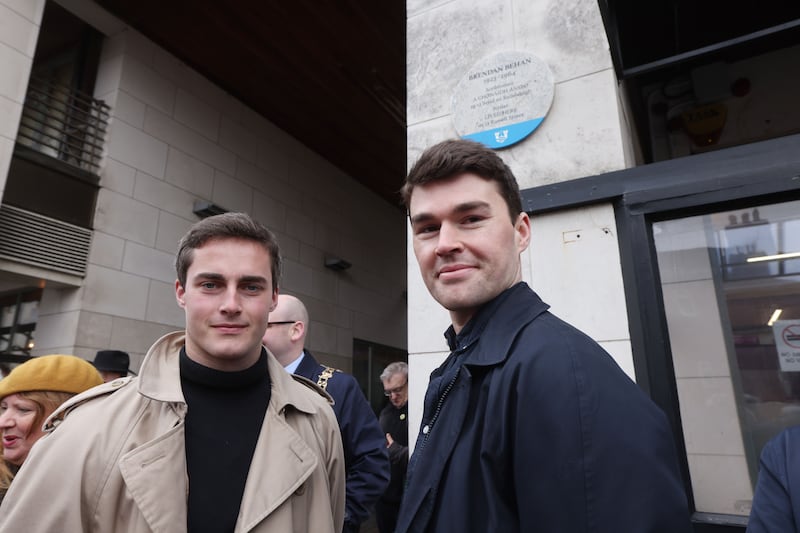
Brendan Teeling, deputy city librarian with DCC, said the council was in 2012 “looking at how it would mark the decade of centenaries but also how it would remember individuals”. The scheme “arose out of that” desire.
RM Block


“It was felt that there was a need to have a formal scheme under which the city could make a formal honour,” he added.
Teeling is a senior official on the council’s Commemorations and Naming Committee, which is made up of elected members and chaired by Cllr Donna Cooney of the Green Party.
During the public consultation on the naming of what is now known as the Rosie Hackett Bridge, which opened across the river Liffey in 2014, he said many names were proposed for the honour. This was the first time suggestions were sought from individuals and groups, with DCC making the final call and choosing to name it after the trade union activist who was involved in the 1913 Lockout and the 1916 Rising.

“I suppose that also fed into this idea that there were so many people who were deserving of being commemorated and obviously, we don’t have a bridge for everybody. So again, that partly fed into the scheme,” said Teeling.
He said granite markers are a good way of doing it as “they’re relatively small things and they don’t cost a whole lot of money”.
The council has set specific criteria that must be met for a plaque to be erected. The person must be either deceased for 20 years or have reached the centenary of their birth, have permission from the owners of the buildings where the plaque would be erected, and have had a “real connection” to the city.
[ The plaques of Dublin: what they do and don’t tell usOpens in new window ]
The nominations are then presented to the councillors, who make the final decision on who is commemorated. Anyone, including members of the public, can put forward a proposal for a plaque. Teeling said this system allowed “people to come to the fore who maybe wouldn’t otherwise”.
He gave the example of Shay Elliott, the first Irishman to win a stage in the Tour de France and wear the yellow jersey. The suggestion to commemorate him came from a member of the public and a plaque was erected in 2023 where he lived in Crumlin.
Teeling said the idea of a smartphone app had been raised “several times”, adding that a better digital platform allowing people to find the commemorative plaques was something the council would be “certainly looking into”.
Cooney, a member of the Commemorations and Naming Committee since 2019 and chair since 2024, said the committee was “welcoming more proposals to commemorate women”.
“It’s self-perpetuating us then ... because they only know the men, they keep saying and they keep asking for the same men,” she said.
“You could have so many facts to one particular man because people know them so well, admire them and they’re right to be admired, but it just happens sometimes that we keep then excluding women ... People don’t know about them, so therefore they don’t suggest them ... and we’re not unique in Dublin or in Ireland, or let alone Europe.”
[ Frank McNally on Dublin street honours big, small and missingOpens in new window ]
She said it was evident worldwide that women were “not generally commemorated,” adding that when they are, monuments are instead dedicated to mythical rather than real women.
Cooney said the committee was looking for an increase in its budget “so we can actually do more within a year”.
One of her favourite unveilings was for Deirdre O’Connell, the founding member and artistic director of the Focus Theatre. Then president Michael D Higgins and his wife Sabina were in attendance due to their “connection” with O’Connell and Focus Theatre. Cooney said this was “particularly poignant” as it was one of the last official engagements Higgins had before his second term ended late last year.

She said she enjoys all the unveilings and that people can find it inspiring to know they are walking in the footsteps of those being commemorated.
In June, DCC launched a new four-phase programme aimed at increasing the visibility of women’s contributions to Irish history through public art, street names, plaques and commemorations. The programme will begin with the commissioning of a monument to honour women of the revolutionary period. This will be located near the GPO on O’Connell Street.
At least three more commemorative plaques have been confirmed for installation later this year.
For the full list of Dublin plaques, click here


