- Antrim, Armagh, Down, Tyrone and Derry are under status yellow rain warnings issued by the UK Met Office until 11.59pm on Friday
- Irish Rail has said all Dart services have resumed in Dublin, though delays continue due to earlier flooding
- The owner of the Clontarf Baths in Dublin has described flood damage caused to the popular amenity as “soul-destroying”
That’s all for our live coverage today. Thanks for following along.
You can read more on this story here.
Saturday’s weather forecast
According to Met Éireann, Saturday morning will start with mist and fog in some areas as cloud and patchy rain persist in northern areas.
It will be mainly dry elsewhere except for the south where there will be scattered heavy showers.
Sunshine will be limited and highest temperatures will range from 7 to 11 degrees.
Saturday night will be mainly cloudy and misty with patches of fog.
Ulster will experience outbreaks of rain and the rest of the country will see scattered showers.
Lowest temperatures of 1 to 5 degrees with light and variable winds.
There is also a small craft warning in place from Erris Head to Malin Head to Strangford Lough from 12am to 4am on Saturday.
Wicklow County Council has said the Bray to Greystones cliff walk remains closed due to “significant safety Concerns.”
Flood defences in Clontarf must be fast-tracked

Clontarf in North Dublin has experienced repeated flooding over the past few days due to excessive amounts of rain and weather warnings.
Flood defences for Clontarf in north Dublin,not expected to be built until 2033, must be fast-tracked following a deluge that saw the promenade entirely submerged on Thursday, local Independent TD Barry Heneghan has said, writes Dublin Editor Olivia Kelly.
For the full story, read here.

Weather warnings currently in place
The only weather warning still in place is for counties Antrim, Armagh, Down, Tyrone and Derry where a yellow rain warning is in effect until 11.59pm tonight
A weather advisory is in place for all of Ireland until February 9th.
A small craft warning has just come into force from 3pm for Erris Head to Fair Head to Howth Head until 12am on Saturday.
Reporter Ronan McGreevy is at Blackrock Dart station where trains are still running during high tide, but with 10 to 20 minute delays.
Iarnród Éireann confirms that Dart services are operating between Greystones to Clongriffin/Howth with 15 to 20 minute delays.
Northern commuter services are operating with delays of more than 15 minutes.
Enterprise/Belfast services are moving with delays of more than 20 minutes.
There is no Dart service operating from Malahide to Clongriffin.
Photographs from south Dublin

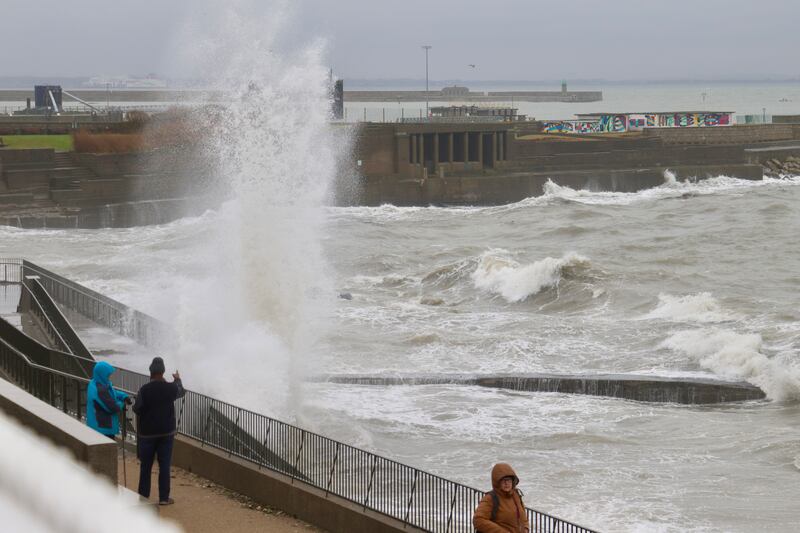
Here are some photographs from our reporter Ronan McGreevy in Sandymount.
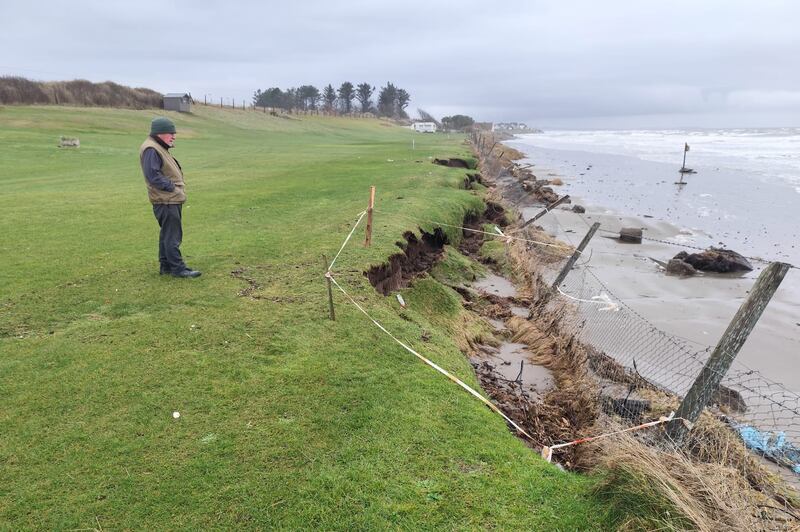

The chairperson of a pitch and putt club which lost over one meter of its course to Thursday’s high tides, said it was ‘heartbreaking’ to watch the amenity gradually succumb to coastal erosion, reports Louise Walsh.
A tee box which now lies teetering at the edge of the wave-battered 18-hole course at Laytown, Co Meath will have to be moved after further damage was caused by the sea during the county’s yellow weather warning.
Chairperson Mark Fay and club members are now in the process of starting a fundraising campaign for measures, including replacement fencing, to try and protect the 51- year old course from further damage.
“I’d say in the last two winters, we have lost over four meters of land, one and a half meters of which was taken by the sea on Thursday. That’s land we will never get back,” he said.
“We will probably have to move at least one tee box because when you stand on it, you are looking right down into the sea. The next wave and it’s gone.
“We are lucky that we have room to shuffle things about. The tide went around the greens which have held up well but there are holes now between them that we need to address.”
The club which lies over two hectares of coastline has 108 members, a further 40 associate members and an additional 60 green fee visitors each week.
Fay estimates that the course has lost 30m to coastal erosion since 2012.
“When you look out to sea and see the life buoys, that is where the course used to be.
“The members have spent about €54,000 on the course in the last two years and we are due to hold our first national title here later this year.”
“I’m just sickened by it all. It’s just a constant battle and it’s heartbreaking.”
Government should apply for EU flooding solidarity fund, MEP says
Given the serious flooding across the country, Barry Andrews MEP suggested Ireland should “rapidly prepare an application for support under the EU Solidarity Fund, which is made available in the EU budget for exactly these natural disasters”.
“The cost to Ireland from Storm Chandra for repairs, clean-up operations and required infrastructure improvements will be significant... The fund helps cover costs of emergency and recovery operations incurred by public authorities following flooding and other disasters,” he said.
Andrews said his office has been in contact with European Commission officials, who confirmed that the overall damage and recovery cost threshold for Ireland to qualify in 2026 is €2.5 million.
“The application must be submitted within 12 weeks since the beginning of the storm, so I would ask the relevant state authorities to now rapidly prepare an Irish application,” he said.
From 2002 until 2024, the Solidarity Fund received 180 applications, of which 129 were successful.
Last year, €280 million was provided to help Austria, Poland, and other states to recover from the serious floods in central and Eastern Europe of the previous year.
Business owner in Clontarf describes “soul-destroying” floods
The owner of the Clontarf Baths in Dublin has described flood damage caused to the popular amenity as “soul-destroying”, saying “nothing has survived”, our journalist, Jack White, reports.
Bobby Nolan, owner of the Clontarf Outdoor Pool, anticipates overall damage costs of €50,000 “at a minimum”, saying everything has been “destroyed”.
On Thursday, he drained the pool, which can hold 2.5 million gallons, in anticipation of flooding and wave overtopping, believing this would offset damage.
“When I came back here yesterday afternoon, the whole pool and the bank was full up to the top of the wall,” he said.
Beginning a cleanup on Friday morning, he said the damage is the “worst ever”.
“I opened here on the 30th of June, 2018, and I’ve never experienced anything like it,” he said.
“It’s wiped out the plant room, it’s wiped out the lift we have here,” he said, adding: “Everything is gone underwater.”
“All our benches, our race lanes, our ladders, our steps, everything is destroyed,” he said.
Nolan said waves began to overtop the wall in December and have been “brewing and brewing” since.
“The damage is huge, it’s like a bomb site. There’s nothing that has survived, it’s soul-destroying really.”
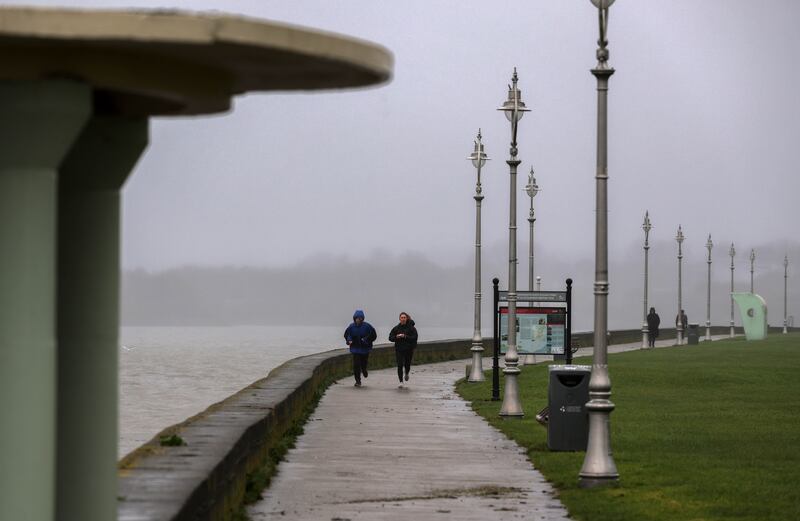
Dublin City Council said it is continuing to monitor river levels and coastal conditions closely.
“Our crews remain active across the city and exploring when flood gates can be reopened. Crews removal of debris at rivers (racks) and blockage clearing is ongoing to minimise negative impacts,” the council said in a statement.
Meanwhile, the DART is still running in Blackrock in south Co Dublin, despite the weather conditions, Ronan McGreevy reports.
The orange rainfall warning has expired for Waterford, however, the City and County Council said there has been “significant damage” to the road network due to persistent and sustained rainfall.
The council’s severe weather management team convened on Friday morning and “continues to monitor the situation, while ground crews have been deployed to deal with road network issues throughout the city and county”.
Gabriel Hynes, director of services with the council asked the public “to bear with us as our teams assess and repair the network”.
“We are advising motorists to continue to drive with caution as the road network has been compromised by heavy rainfall, river run-off and coastal flooding, and there may be debris, damage, and surface water on some roads,” he said.
“We would also remind drivers to avoid driving through flowing or standing water, expect the unexpected and be conscious of vulnerable road users such as pedestrians and cyclists.”
Some roads and areas have been affected by flooding in Co Louth, the local council said, but there have been no major incidents.
Very little flooding in Dublin so far
There was relief for residents in the Dodder Park Road area of Rathfarnham in Dublin this morning, our journalist Ronan McGreevy reports. Despite further heavy rain, there was no repeat of the deluge of rain from a broken culvert which caused flooding in the Woodside estate and Dodder Park Road partially submerging many cars in water. Dodder Park Road was open to traffic this morning.
With the impact of flooding not expected to be known until tomorrow, Met Éireann’s latest forecast says tomorrow’s weather will be misty and foggy in some areas, with cloud and patchy rain persisting in northern areas. However, it will become mainly dry elsewhere, with scattered heavy showers will affecting the south and sunshine will be limited.
‘Culture of judicial reviews’ affecting progression of certain flood relief schemes, says Minister
Minister for Public Expenditure Jack Chambers has called for a “greater public acceptance” of infrastructure, saying people must “think twice” before lodging judicial reviews when there is a level of risk.
Speaking on RTÉ Radio’s Today with David McCullagh, Chambers said the “paralysis” that feeds from the “culture of judicial reviews” in recent years is affecting the progression of certain flood relief schemes.
He noted that “certain residents’ associations” have halted flood defence schemes through judicial reviews “in communities that have been flooded in recent days”.
“I think the balance of rights isn’t there in the Irish system right now, and judicial reviews are bringing huge elements of risk aversion across the decision-making process,” he said.
He said flood defence schemes are also complex environmental projects, saying he accepts the “frustration” of those living in Enniscorthy, Co Wexford, where plans for such a scheme were affected due to the pearl mussel, which “I think many people would be shocked at”.
Chambers will be bringing measures to Cabinet next week that seek to cut delivery timelines, he said.
Projects estimated to cost up to €500 million would see fewer steps in the approval process by increasing the threshold at which measures such as an external assurance process kicks in. The current threshold is €200 million.
He added that he will also be bringing the Critical Infrastructure Bill to Government in the coming weeks, which aims to allow specific projects be fast-tracked, applying emergency powers where necessary.
In Tullow, Co Carlow, the council continues to monitor rising water levels from the river Slaney. Rain water flowing down from the Wicklow mountains is adding to the already swollen river.
In Enniscorthy, the Slaney Search and Rescue teams, who came to the aid of dozens of people impacted by last week’s heavy rain, were left to mop up their own premises and the loss of items following heavy floods caused by Storm Chandra.
In a statement, Slaney Search and Rescue said that while their operational kit is “thankfully waterproof”, they did sustain water damage to irreplaceable items, including “photographs of past members (and) a reminder that even when equipment can be replaced, memories cannot”.
The statement continued: “While conditions allowed, we also brought the boats out to recover equipment and took the opportunity to do some light training with our newer members.
“Even in difficult circumstances, maintaining readiness and supporting the team remains a priority.”
They said that their thoughts are with everyone impacted by the flooding.
Why is it raining so much?
Our climate and science correspondent Caroline O’Doherty has written a piece examining why it’s raining so much.
For an answer to that, O’Doherty writes, we have to look far above and beyond the clouds overhead.
Read the full piece here.

Impact of rainfall won’t be known until later today or tomorrow
Although rainfall overnight was not “quite as heavy” as predicted, conditions will be “difficult” on Friday and the effects in some areas might not be felt for some time, according to the chairman of the National Emergency Coordination Group (NECG).
“We’re hopeful that we might get away today without too much damage to property, but I think you’ll see roads flooded and, particularly along those coastal areas, I think you’re going to see more coastal overtopping throughout today and tomorrow,” Keith Leonard told RTÉ Radio’s Morning Ireland.
“Unfortunately, we have the coincidence of very high tides, surface flooding and very high river levels.”
He added that rainfall over the Wicklow Mountains will flow into south Dublin, Co Kildare and Co Wexford over the next 24 or 48 hours, saying: “We won’t really know the impacts until later today or early tomorrow.
“We’re on full alert right throughout the weekend. Rainfall will be much lower throughout the weekend, thankfully, but that lag will continue to have an effect across the weekend,” he said, adding that more rainfall is expected on Monday and Tuesday.
Noting that the NECG is meeting at noon today, he said the key focus will be restoring public transport while also ascertaining if there has been damage to properties overnight.
Leonard advised those attending work on Friday morning to “slow down”, and to avoid driving through flooded water, saying “every day this week, we’ve had to rescue people from trapped cars”.
“They’re dangerous and it causes a lot of stress for people when that happens.”

Employers urged to be ‘understanding’ of employees unable to travel due to weather
Employers who insist on employees travelling to work during weather warnings could be liable for any harm caused, according to a human resources professional.
Damien McCarthy, founder and chief executive of consultancy firm HR Buddy, told the programme there is a “duty of care” for employers, which involves travel to and from work during extreme weather events.
“This morning, for example, public transport has been impacted. So if you’re forcing employees to travel in these kinds of weather conditions, putting them at risk, yes the employer can be liable,” he said.
McCarthy added that while there is no statutory legal requirement for employers to pay workers who do not attend work during extreme weather events, he urged employers to afford “understanding and compassion”.
Dublin weather warning reduced to status yellow
Dublin’s weather warning has been reduced from a status orange to yellow for rainfall, according to the latest update from Met Éireann.
Timings for weather warnings across the country
The end of orange and yellow warnings for rain have been brought forward. The updated list of warning times is as follows:
Orange
- Dublin, Wicklow, Waterford: warning valid to 9am Friday
- Louth: warning valid to midday Friday
Yellow
- Carlow, Kildare, Kilkenny, Laois, Wexford, Tipperary: warning valid to until 9am Friday
- Cavan, Monaghan, Meath: warning valid to midday Friday
- Antrim, Armagh, Down, Tyrone, Derry: warning valid to midnight Friday
Rail services are in a “better situation” than yesterday, according to an Irish Rail spokeswoman, with full services expected to resume on Friday.
Jane Cregan said water has receded on some lines that experienced “very bad flooding” on Thursday.
Dart services are now operating between Greystones and Howth after flooding abated, she said, though there are “minor delays” to services on the line.
The line between Greystones and Wicklow, meanwhile, is closed due to debris and flooding on the line, with a bus transfer operating on the route.
“We’re in a better situation than we were yesterday, but we do still have some minor impacts,” she said, speaking on RTÉ Radio’s Morning Ireland.
Weather warnings to end earlier than expected, says meteorologist
Weather warnings are to finish early as rain is moving north “quicker than anticipated”, says meteorologist Mark Bowe.
Speaking on RTÉ Radio’s Morning Ireland, Bowe said that although this signifies the end of “persistent and heavy rain”, localised and river flooding impacts “will still persist” after the warnings cease.
Parts of Louth experienced the heaviest rainfall overnight, he said.
“We certainly saw some very heavy rain right across parts of the east in the Wicklow Mountains, and certainly parts of the northeast around Louth,” he said, adding that it “started to taper off” overnight.
Irish Rail has said some of its services have resumed, including Darts between Greystones and Clongriffin, in both directions. The Belfast and Northern Commuter is also resuming, albeit with “significant delays” expected.
Changes to weather warning timings by Met Éireann
Some of the weather warnings for various counties have been rolled back by a few hours in the latest update by Met Éireann on its website.
Dublin and Wicklow’s warnings have been changed to expire at 9am.
Louth now expires at 12pm as well as Cavan, Monaghan and Meath.

National Emergency Coordination Group due to meet at noon today
The National Emergency Coordination Group (NECG) urged people in Dublin, Louth, Wicklow and Waterford, all under orange rainfall warnings, to work from home on Friday if possible.
The NECG is due to meet again at noon on Friday. The meeting will also be attended by a humanitarian subgroup and a Liffey catchment area subgroup.
Local authorities said yesterday that they had made sandbags available to homes and businesses most at risk of flooding.
South Dublin County Council reports that its crews were continuing to monitor river levels overnight, with river levels remaining high and rain falling on saturated ground.
More transport disruption
A number of Bus Éireann routes have been cancelled.
There are cancellations on Route NX from Dublin to Navan and Navan to Dublin, Route 109X from Dublin to Cavan and Cavan to Dublin, Route 109 from Kells to Dublin, and Route 115 from Dublin to Enfield and Enfield to Dublin.
The operator apologised for any inconvenience and urged passengers to check its website and social media channels for further information and updates.
A number of train and Dart services have been suspended due to the weather conditions and flooding. Bus transfers are available, and Irish Rail is reminding people that Leap cards are valid on all TFI services in the affected areas.
Services currently cancelled:
- 05:35 Rosslare/Connolly, bus transfers to Connolly
- 05:45 Gorey/Connolly, bus transfers to Connolly
- 07:10 Rosslare/Connolly will operate to Wicklow, bus transfers from Wicklow to Connolly
Additionally, the Malahide to Howth Junction Dart and Northern Commuter are suspended due to a mechanical fault with a maintenance vehicle, which Irish Rail is working to rectify. Bus transfers available from Rosslare/Gorey to Wicklow/Bray, with debris and flooding on line.
Rain to be heaviest in east and northeast with risk of flooding, says Met Éireann
Met Éireann’s latest forecast, updated at 5am this morning, says it will be a very wet, cloudy and blustery morning, with rain continuing to spread north.
Rain is expected to be heaviest in the east and northeast with the continued risk of flooding.
It will stay rather overcast into the afternoon as the rain becomes confined to Ulster and scattered showers follow in from the south, the forecaster said.
The forecast shows it’s due to stay cloudy and rather wet with scattered showers into the night, with showers will at their heaviest and most persistent across Munster. There’ll be asterly breezes and lows of 3 to 6 degrees with some mist patches forming overnight too.


