

There are certain places we feel we know long before we arrive.
Egypt was one of those places for me. The pyramids, Tutankhamen, the Nile – stories and images absorbed over a lifetime, until standing in front of them feels strangely familiar and completely extraordinary at the same time.
I had expected to be overwhelmed by the monuments. I hadn’t anticipated quite how absorbing the history would become, or how much of Egypt would stay with me beyond it.
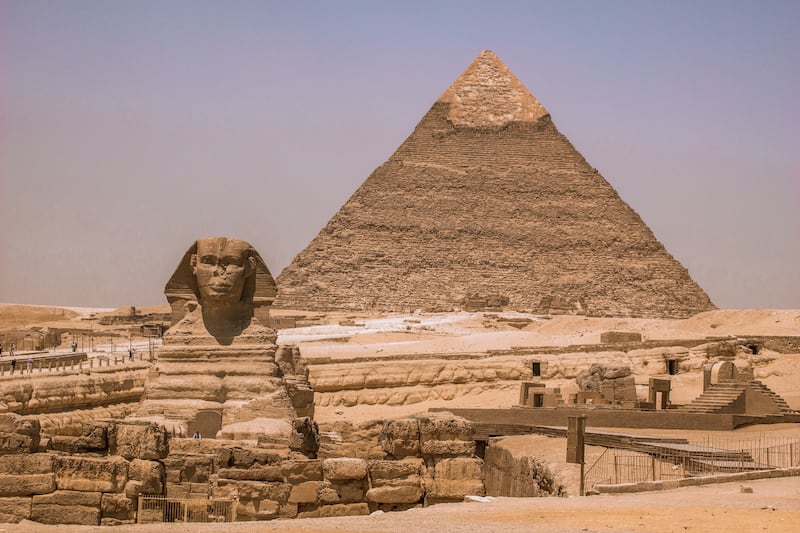
The story begins in Cairo
We crossed the Giza plateau by golf buggy with our private Egyptologist, the pyramids growing steadily larger across the sand until we were standing beneath them. Even at close range, their scale is difficult to reconcile with their age.
RM Block


Our Egyptologist was already drawing us into a larger story, pointing out symbols and beliefs we would encounter again further south. He had a wonderful habit of asking us to remember something. Its significance would become clear days later.
At the Grand Egyptian Museum, it was the smallest objects that stayed with me. Among Tutankhamen’s treasures were his shoes, walking sticks and bed. These intimate possessions brought an unexpected humanity to the golden mask I had known since childhood. Behind one of history’s most celebrated archaeological discoveries was a boy whose life had been remarkably short.
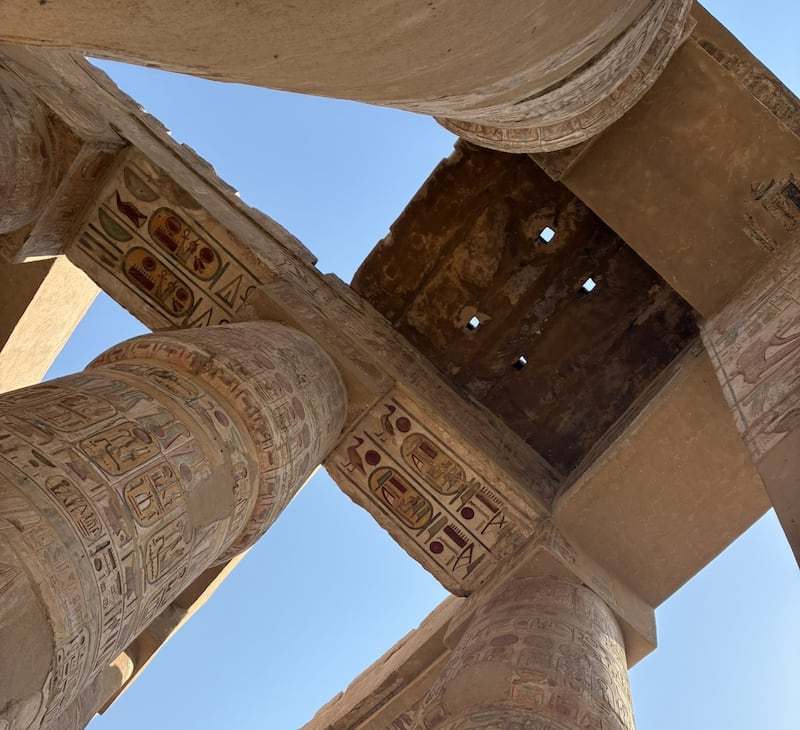
In Luxor, where the story comes together
The change from Cairo is immediate. The city gives way to the vivid green of the Nile Valley, with fields and palms running alongside the river.
Our Egyptologists had a wonderful instinct for making connections. A story introduced almost casually in Cairo might return days later, suddenly legible in the stone before us. I began to understand why ancient Egypt could occupy a lifetime of study.
Hatshepsut was the site that surprised me most. Her temple rises in terraces against the cliffs of the West Bank, its architecture almost inseparable from the landscape. But her story is every bit as compelling: a woman who claimed the authority of a pharaoh and ruled Egypt as king. In a history so often told through the achievements of men, there was something particularly wonderful about standing before a monument to one of its most formidable women.

The Nile by dahabiya
For five nights, we travelled south towards Aswan aboard a dahabiya, a traditional sailing boat with just 10 cabins. Unlike the larger cruise ships, it sits low on the water, close enough to the banks that you feel part of the landscape rather than simply passing through it.
Life on board had its own lovely rhythm. Within a day, the crew knew everyone. Cold towels and drinks appeared after sightseeing, Egyptian dishes were shared around long tables and tea arrived at sunset. One evening, we dined beneath the stars on a small island, ending the night dancing with the crew. Somewhere along the way, the formality of being guests had disappeared.

But it was life along the river that I loved most. In the mornings, there was a wonderful stillness to the Nile. Fishermen worked from small boats, birds skimmed the reeds and water buffalo gathered at the water’s edge. Beyond the impossibly green strips of farmland, the desert began almost without warning.
Then there were the children. As we passed villages, they would swim out towards us or appear alongside in tiny boats, sometimes catching hold of a rope and letting the dahabiya carry them along. Their delight was infectious: enormous smiles, laughter carrying across the water, triumphant thumbs-up before they eventually let go and waved goodbye.
There was such unguarded happiness in these fleeting encounters. They lasted only minutes, yet I remember them with an affection quite disproportionate to their brevity.

At Gebel el-Silsila, sandstone cliffs rise directly from the Nile, carved with shrines and tombs left from the ancient quarries that supplied stone for many of Egypt’s temples. I had only just come back up on deck and could easily have missed it. For a few minutes, I was there alone as the dahabiya sailed slowly past the carvings. The river was almost silent and, as the cliffs moved alongside us, white birds swept overhead.
With our private Egyptologist and more flexibility than the larger cruise ships, we could time temple visits to avoid the busiest periods.
At Edfu, we entered the Temple of Horus with relatively few other visitors. Enormous columns rose overhead, while shafts of light caught the carvings in its darker chambers.
Kom Ombo tells a different story. Our Egyptologist explained how closely the ancient Egyptians observed the natural world, from the behaviour of crocodiles to the seasonal flooding of the Nile and the movements of the stars. These observations shaped their understanding of time and the calendar, a remarkable intellectual legacy still recorded in the carvings.
By the time we reached Aswan, I thought the great temples were behind us. Egypt had saved one more.
Philae sits on an island, reached by a small boat across the water. As we approached, its great pylons rose ahead of us, seemingly straight from the Nile.
As the sun began to fall, we boarded a felucca and sailed between the islands. There was no temple to reach and nothing left to tick off. We simply sailed, watching the light change across the river, the desert beyond and the Old Cataract on the bank.
After days spent trying to take in thousands of years of history, it was a beautifully simple way to say goodbye to Egypt: under sail, as the sun went down over the Nile.

Why Egypt now?
Egypt is entering a new chapter. The Grand Egyptian Museum has given Cairo a remarkable new centrepiece. Mandarin Oriental is restoring the Winter Palace in Luxor and transforming Aswan’s storied Old Cataract. Yet for me, Egypt’s greatest appeal lies in the way you experience it. The right Egyptologist, the freedom to explore slowly and the intimacy of a small sailing boat on the Nile.
The ancient world may be what takes you to Egypt. The journey down the Nile is what makes you want to return.
Explore Oroko’s Egypt by Dahabiya journey, call 01 260 0240 or email info@orokotravel.ie


