An unpopular Republican president responsible for a catastrophic war in the Middle East helps Democrats regain control of both houses of Congress. That’s what happened in 2006, when George W Bush was US president. Twenty years later Democrats are hoping for a repeat of that result, which was the last time they had a truly great midterm election. Today’s election may be especially consequential with some crucial questions to be resolved.
Will Donald Trump try to interfere with or discredit the elections?
Trump denied the results of the 2020 election and backed an insurrection to overturn them, so it would not be a surprise if he again meddles in the democratic process. The most likely way he would do so today would be to send federal agents to polling places to deter voters who might be afraid of immigration officers. It is also possible that vigilantes acting in Trump’s name and mindful of his pardoning of January 6th insurrectionists will take independent action to deter Democratic voters. Such voter suppression tactics would be effective because there is no real way to count votes that haven’t been cast, but they would only swing results in very close elections.
But it seems that Trump is focused less on altering election results than on discrediting them after the fact. Trump has offered a $1 million reward to any American who reports a case of voter fraud that leads to arrest and conviction. That smacks of desperation, as – despite Trump’s repeated claims – voter fraud is almost non-existent.
And yet claims of fraud could be used as a pretence by Republican state officials to refuse to certify the election of Democrats. Pay close attention to what happens in Alaska where staff linked to the Democratic candidate Mary Peltola allegedly helped recruit the independent candidacy of Dan Sullivan to confuse voters intending to cast a ballot for the Republican candidate of the same name. This was a dirty trick, but it was not illegal, and Democrats will point out that Republicans have done similar things. Yet Trump has already made moves to prevent Alaska from certifying the result if the Republican Dan Sullivan loses, and Alaska’s governor has indicated he might not certify her election.
Trump proclaims ‘golden age’ while US midterm polls are flashing historical defeats

Don’t make an additional voluntary contribution to your pension – until you read this

Trump has done two things to free his voters from the pact they made with him

‘A surprise to everybody’: Family denies organising 4.5m-high memorial in Sligo Cemetery

Anywhere there are close election results, there is a heightened risk of accusations of fraud, pressure on Republican officials not to certify results and the potential risk of political violence. The nightmare scenario is if control of the Senate comes down to a few thousand votes in a Republican-controlled state.
What will happen in the key states like Iowa and Kansas?
Unless the polling is very wrong, Democrats will regain control of the House of Representatives. But there are an unusual number of close races in the Senate, where Democrats need to win four seats to regain the Senate. If Democrats gain the seats where they’ve consistently held polling leads – Alaska, Maine, North Carolina, Ohio, and Texas – they will hold 52 seats. Anything less than this would be a disappointment. But all of these races save North Carolina are close and Democrats also need to hold Senate seats in Michigan and Minnesota, both of which they could lose on a bad night.
If Democrats have a good night, they could make historic gains in the Senate. Iowa and Kansas are extremely close. South Carolina is also in play as is Nebraska where independent candidate Dan Osborn could unseat a Republican. Florida and Mississippi are long shots, but not out of the realm of possibility. So, while 52 seats is the safe bet, it’s entirely possible that Democrats fail to take the Senate or that they wind up with 55 seats or more. This is important not just for next year but – since Senators serve for six years – to give a Senate majority to whomever wins the presidency in 2028.
What will happen to the 33 election deniers in 21 states?
Elections are not just being held for federal offices, but for state and local offices from governor all the way down to school board member. Some future star of American politics might be getting their start on Tuesday as did Barack Obama when elected to the Illinois State Senate in 1996.
But the main thing to watch today is the success of statewide Republican candidates who claim the 2020 presidential election was stolen. There are an estimated 33 such election deniers running for statewide offices in 21 different states. Because states conduct all elections for federal office, an election denier in high office – especially in a battleground state – increases the chances that Republicans seek to overturn the results of the 2028 election. Trump tried this in 2020 when he infamously asked the Georgia Secretary of State to “find” him enough votes to win the state. Control of governorships and state legislatures could permit either party to gerrymander Congressional maps to their advantage.
How will the midterms set the scene for the presidential primaries?
The one thing that Republicans have going for them today is low expectations. If they overperform the polls and retain the Senate, they will claim this as a victory – much as Joe Biden did in 2022, despite Democrats losing control of the House of Representatives. This might convince Republicans to stay the course and in 2028 nominate someone closely identified with Trump’s MAGA movement such as vice-president JD Vance.
However, if Republicans suffer big losses, they would be better off nominating someone with some distance from Trump. After the 2006 midterms, Republicans nominated John McCain. But a Republican Party remade by Trump has no equivalent to McCain. Based on some of the poor Senate candidates they are running today, Republicans seem to care more about ideology and loyalty to Trump than they do about electability.
On the Democratic side, a big win would augur a 2028 presidential victory and might convince primary voters to choose a progressive such as Alexandria Ocasio-Cortez as its candidate. Conversely, a disappointing night could lead it to select a moderate. Two Senate races bear especially close watching. The first is in Michigan where Abdul El-Sayed – identified with the left wing of the party – is seeking to become the first Muslim elected to the Senate. A convincing win by him would increase Ocasio-Cortez’s chances (she has said that “if Abdul can win Michigan, anyone can win anywhere”) while a loss would probably convince her not to run.
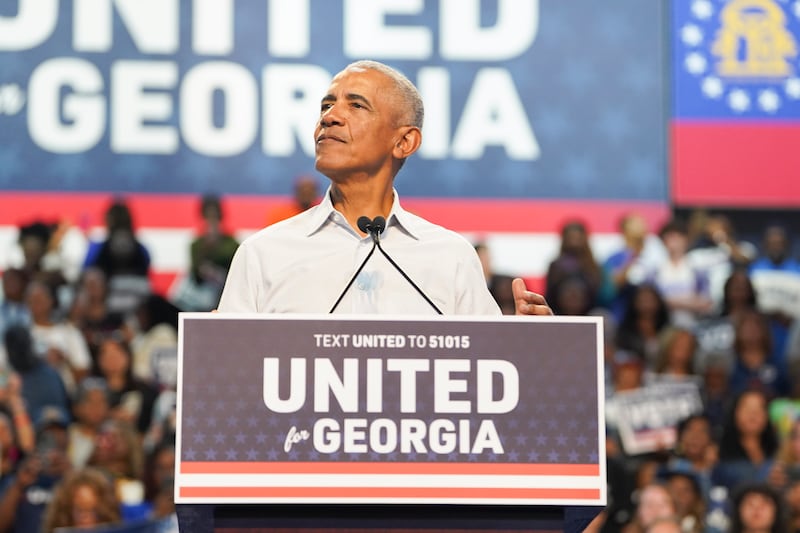
Meanwhile, in Georgia Jon Ossoff seems to be coasting to re-election to the Senate. This is a very impressive feat, even against a weak Republican candidate, in what is typically a closely fought state. If Ossoff wins by double digits as expected, he will have a strong argument that he gives Democrats the best chance to win back the White House.
Daniel Geary is Mark Pigott Professor in American History at Trinity College Dublin
How we’re covering the US midterms