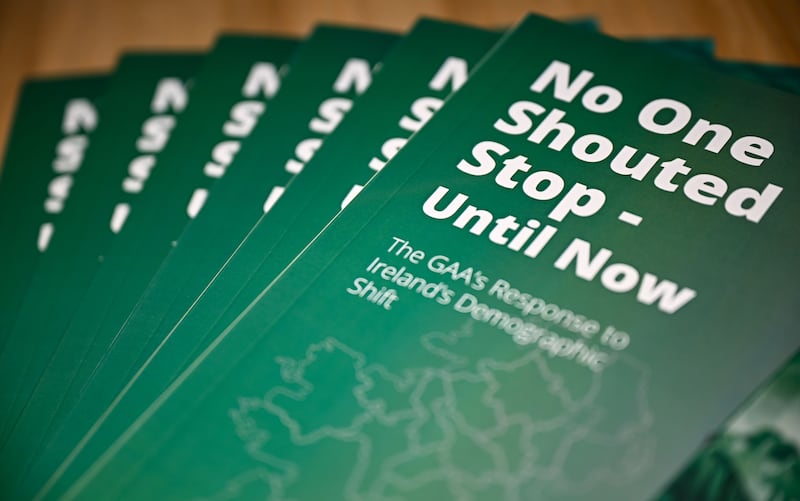
The GAA were very conscious on Thursday when launching the report of their demographics committee that the concerns expressed were not new.
Previous landmark publications, from the MacNamee Commission in 1971 and 2002’s Strategic Review Committee both sounded alarms on the consequences for Gaelic games of rural depopulation and the migration eastward.
What the association said it was determined to do on this occasion was to devise and implement strategies to counteract the decades-long drift.
GAA president Jarlath Burns was asked whether without Government engagement and support, was the report not merely about managing decline.
RM Block


“That’s right and that was my very first comment, that the population shift and the GAA clubs do not align any more. We have to be agile and nimble in how we organise ourselves around that but we’re also relying on Government to help us as well.
“They can help us in numbers of ways. For example, there is a shameful lack of local authority GAA pitches. In a lot of local authorities they say, ‘well we’ll provide soccer pitches, a smaller piece of ground. The GAA always look after themselves. They’ll fundraise and they’ll build a pitch’.
“That’s not taking consideration the rise of the GAA and the inability of us really to buy land any more. And I think the local authorities have a lot to answer for in their lack of provision for GAA pitches.
“The second thing then is I think we know that an awful lot of people who are deciding to leave, they’re leaving places where there are jobs ... they just wanted to live in an urban area.
“There’s no problem with that but when they arrive in that urban area with their children, they’re finding it very difficult then to express themselves from a GAA perspective because of the lack of pitches.”
An associated concern is the availability of recreational space in urban development plans. Burns said that this was an acute problem south of the Border.
“There are in some countries, actually across the Border, [rules] that if you build so many houses, you also have to put in a certain amount of green spaces as well.”
He also said that the committee had looked at the fate of mining communities in South Wales after pits had closed.
“Community died and as a result, rugby is dying as well. So, we know that when community dies, the GAA dies with it in these areas. And we have to ask ourselves, closing up the shop, the Garda station, the train station, the bus stop, all of those things that I mentioned – do we want this? I don’t think Irish people do.”
He said that one of the inspirations behind proposals to allow a more flexible approach to the games was interaction with the overseas units, which have been floating the possibility of being allowed to have teams rather than clubs.
“It’s a lot easier to form a team than it is to form a club,” according to Burns. “You don’t have to have a chair and secretary and account and all that. You just have people who want to play and let them play.
“And as we approach integration, all of these things are going to be salient and important and significant as we completely restructure for a new organisation.”
Another strategy, which is already widely practised in areas of falling population is amalgamation, initially at underage levels, but in some cases senior as well.
“I think we need an amalgamation toolkit because the problem is you’re asking clubs to amalgamate with their deadliest rivals.”
On the parallel topic of establishing new clubs in areas of rising population, the president suggested that a specialist unit in Croke Park take charge of issuing authorisation.
Eastern Gaels in Meath was founded as recently as 2023.
“That whole area has had a population explosion but that club was formed out of a little bit of dissent within the other club. And they had to go then to the Meath County Board for a majority of people to vote.
“That got mired into the whole politics of the area. When I visited that club, they said, ‘please make it easier for a new club in an area that needs a new club to form’.
“That should not go to the county board. That should go to a central, maybe demographics unit, that would ask, ‘is there scope for a new club there? Do we need a new club? What are the motives behind those people setting up a new club?’ ”
Demographics committee chair, Benny Hurl, said that they would be bringing forward two motions to congress: one to ameliorate the requirement that to be a club, a unit had to field adult teams in championship; the other to bring flexibility to minimum numbers for championship teams.
“What we’re proposing, very simply, is to go down to 11-a-side. That will allow county committees to organise competitions at 11-a-side and that will help the smallest, weakest, most vulnerable clubs.”