Russian president Vladimir Putin was “astonishingly reckless” and bears “moral responsibility” for the nerve agent death of Dawn Sturgess, an independent inquiry has concluded.
Ms Sturgess (44) died after being exposed to the chemical weapon known as Novichok, which was left in a discarded perfume bottle in Amesbury, Wiltshire, in July 2018.
It followed the attempted murder of former spy Sergei Skripal, his daughter Yulia and then-police officer Nick Bailey, who were poisoned in nearby Salisbury in March that year.
They were harmed when members of a Russian GRU military intelligence squad smeared the nerve agent on Mr Skripal’s door handle in a “public demonstration of Russian power”.
[ What is Novichok?Opens in new window ]
In the Dawn Sturgess Inquiry’s final report, published on Thursday, chairman and former UK Supreme Court judge Anthony Hughes concluded that the attempted assassination of Mr Skripal “must have been authorised at the highest level, by president Putin”.

The chairman of the inquiry, which cost £8.3 million, said GRU agents Alexander Petrov, Ruslan Boshirov and Sergey Fedotov were “acting on instructions” when they carried out the attack.
Following the report’s publication, Mr Hughes said: “The conduct of Petrov and Boshirov, their GRU superiors, and those who authorised the mission up to and including, as I have found, President Putin, was astonishingly reckless.
“They, and only they, bear moral responsibility for Dawn’s death.”
The 174-page report read: “All those involved in the assassination attempt (not only Petrov, Boshirov and Fedotov, but also those who sent them, and anyone else giving authorisation or knowing assistance in Russia or elsewhere) were morally responsible for Dawn Sturgess’ death.
“Deploying a highly toxic nerve agent in a busy city was an astonishingly reckless act.
“The risk that others beyond the intended target, Sergei Skripal, might be killed or injured was entirely foreseeable.
“That risk was dramatically magnified by leaving in the city a bottle of the Novichok disguised as perfume.”
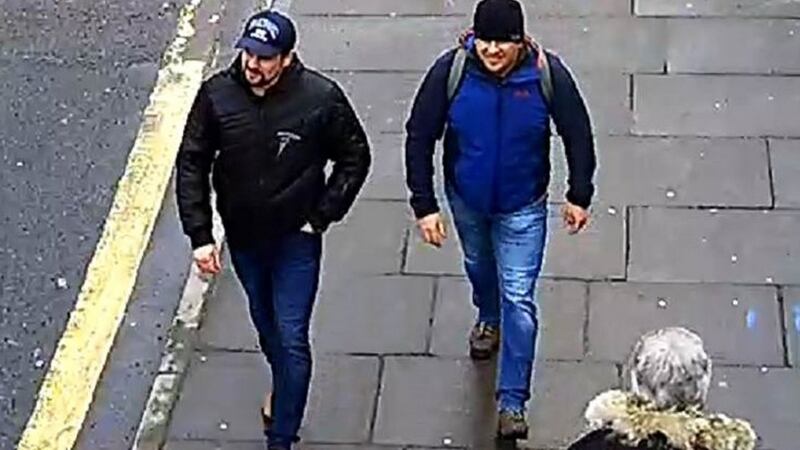
The chairman said there was a “clear causative link between the use and discarding of the Novichok by Petrov and Boshirov, and the death of Dawn Sturgess”.
The pair gave an interview with Russian state media in which they said they were only in the UK, briefly, to visit Salisbury Cathedral.
The chairman rejected the claims made by the pair that they were visiting Salisbury as tourists, describing the interview as “not credible”.
Mr Hughes also addressed the security around Mr Skripal’s home and concluded that even if CCTV was available, the GRU agents were “not likely to be deterred by cameras”.
He said: “It is clear that this attack showed considerable determination and was expected to stand as a public demonstration of Russian power.
“Attackers willing to run the risk of being seen approaching the front door by the occupants or by neighbours – and who must have been willing to accept that the use of a nerve agent would soon be discovered – were not likely to be deterred by cameras, hidden or otherwise, if their plan was to be on a plane leaving the country the same evening.”
The report added: “The attack on Sergei Skripal by Russia was not, it seems clear, designed simply as revenge against him, but amounted to a public statement, for both international and domestic consumption, that Russia will act decisively in what it regards as its own interests.”
The chairman concluded that although there were failings in the management of Mr Skripal following his prisoner exchange in 2010, the assessment that he was not at significant risk of assassination was not “unreasonable”.
He also said the risk to Mr Skripal was “not so severe as to demand such far-reaching precautions” as providing him with an “entirely new identity”.

The report said: “I have concluded that there were failings in Sergei Skripal’s management as an exchanged prisoner; in particular, sufficient, regular written assessments were not conducted.
“However, I do not think that the assessment that Sergei Skripal was not at significant risk of assassination by Russian personnel can be said to have been unreasonable, although, of course, events unhappily demonstrated that it was wrong.
“Nor, for the same reasons, do I consider that the attack on Sergei Skripal ought to have been avoided by the kind of additional security measures which I was asked to consider.
“The only such measures which could have avoided the attack would have been such as to hide him completely with an entirely new identity, and to prevent him and his family from having any continued contact.
“As at 2018, the risk was not so severe as to demand such far-reaching precautions.”
The Skripals did not give oral evidence at the inquiry over fears for their safety, while Charlie Rowley was excused for health reasons.
The inquiry heard the Skripals fell ill on the afternoon of March 4 2018 after eating lunch at a branch of Zizzi in Salisbury.
They were showing symptoms consistent with both nerve agent poisoning or organophosphate poisoning and an opiate overdose.
Paramedics treated Mr Skripal with an anti-opioid drug, which had no effect.
Addressing the medical care Ms Sturgess received, Lord Hughes said no treatment “could in fact have saved her life”.
The inquiry previously heard 87 people were admitted to A&E after the Novichok was discarded in a Nina Ricci perfume bottle.
The report said: “I am satisfied that Dawn Sturgess received entirely appropriate medical care – both from the ambulance staff who responded to the emergency call and from the hospital doctors.”
It added: “I am sure that no medical treatment could in fact have saved her life.”
Russia has previously denied any involvement in the attack on the Skripals.- PA