

Emmanuel Macron had a spring in his step. Passing the reporters who were accompanying him on his four-day trip to the Gulf this week, he gave them a wink.
It was a turnaround in the French president’s mood. He had left Paris for Kuwait on Sunday October 18th under a cloud.
The remains of Limoges town hall were still smouldering. While the worst of the unrest had abated, bands of youths still roamed the Marais district of Paris looking for shop windows to smash. The president’s grave address to the nation on Sunday evening had fallen flat.
But now Macron had a win to announce: he had secured shipments of liquefied natural gas from Qatar to furnish France through the winter, and extra sales of diesel from the United Arab Emirates and Bahrain.
RM Block


The deal would have a “direct impact on French citizens”, Macron told reporters, and “avoid the shortages that suppliers have been anticipating”.
Yet the press did not allow him to dwell for long on his success.
“Mr President, 24 hours after your much-criticised address to the French people, there’s a call for fresh protests this Saturday, October 24th,” a reporter began.
“Violence, vandalism, looting, the town hall of Limoges in ashes ... Are you concerned about a return to violence? Are you concerned about losing control?”


As he approaches the end of his final term as president, Macron faces a bleak conclusion to 10 years in power.
His aims were ambitious when, at age 39, he was elected in 2017 at the head of a newly-created political movement uniting France’s centre ground, promising to rise above France’s traditional divisions and bring competent people from outside of politics into a government that would revive economic growth.
A decade on, France is more divided than ever. Polls show an electorate polarised between hard-core left and right candidates, with the centre ground fragmented.
This week, the cost France must pay to borrow exceeded 5 per cent for long-term bonds for the first time since 2002 as spooked investors noted the political division, scenes of unrest, and one of the highest budget deficits in the euro zone.
Public debt has ballooned, as government spending careered out of control during the Covid-19 pandemic and struggled to come back down afterwards.
[ Europe’s angry autumn: what’s driving the wave of protests?Opens in new window ]
It was whispered that France, perhaps even more than a possible artificial intelligence bubble, could be the trigger for a new global economic crisis.
At the heart of the sense of crisis is France’s hung parliament, which limits the government’s ability to act. It’s the consequence of a disastrous decision by Macron to call a snap election in the summer of 2024, which lost his centrist coalition its parliamentary majority.
While cutting an impressive figure on the international stage, Macron’s achievements at home have long been seen as more mixed.
Renaud Foucart, an economist at the University of Lancaster, believes a failure to reform France’s pension system, which hobbles public finances, will be Macron’s “main domestic legacy as president”.
“A man elected with a huge majority to reform, who failed to do so, leaving a divided country of angry people who don’t seem to understand the cause of their problems,” Foucart summarised.
There was a note of gravity to the announcement from the Élysée Palace last Sunday afternoon that the head of state would address the French people that evening.
Live television channels switched to show the president as the clocks struck 8pm.

“I speak to you this evening at an extremely grave moment,” he began from his desk within the gilded Élysée Palace, the flags of France and the European Union stationed behind him.
The government was “doing the maximum” to address high fuel prices, he said, and working on solutions for problems raised by students. “We’ll go on taking action.”
Local authorities would consider whether to allow further demonstrations, he said, and might refuse some – something they do already. “We need unity, calm and respect.”
When a radio producer called this reporter shortly afterwards to ask what Macron had said, it was difficult to pinpoint anything in particular.
Baffled commentary broke out among politicians, officials, journalists and the general public, asking why the president had announced an address to the nation only to have little to say.
“I would have preferred decisions,” Édouard Philippe, a centre-right politician who served as prime minister under Macron, wrote in a public message addressed to the president. “Our country needs to be governed.”
Others were harsher. “Emmanuel Macron’s address is deeply worrying,” wrote the conservative presidential candidate Bruno Retailleau. “The president of the Republic appears completely overwhelmed.”

Protesters and their sympathisers said Macron should have announced actions to meet their demands; others called for the declaration of a state of emergency to restore order.
Macron left the country almost immediately afterwards to begin his Gulf tour.
[ ‘There’s nothing left’: French businesses count the cost of a weekend of unrestOpens in new window ]
“A few of us tried to dissuade him from leaving, but he was determined,” an adviser to Macron, François Heisbourg of the International Institute for Strategic Studies in London, told French newspaper Le Monde.
The trip is “out of touch with reality, showing that the president has not grasped what is happening in the country”, Heisbourg said.
The far-right National Rally, whose support has risen in polls since the unrest, promised its supporters it would restore the authority of the state if Marine Le Pen is elected president in six months’ time.
“Faced with scenes of insurrection and civil war that engulfed the country, the government abdicated,” the party told supporters.
Macron brushed off the criticism, telling reporters that it was important not to show “nervousness” and “stick with the original plan”.
“The hand must not tremble at the head of the state,” he said.
On his return to France, Macron convened a series of meetings, summoning the intelligence services to the Élysée on Thursday morning and resuming talks with the main political parties.
Macron seemed all business as he made public remarks afterwards. It quickly became clear there would be no declaration of emergency.
“The general recommendation is that there be no demonstrations in the coming days,” he announced. Only protests by trade unions would be permitted, and they would be directed away from city centres “to ensure calm, to protect businesses, and to protect public buildings”.
A student protest amassed in Paris’s 13th arrondissement as the news trickled down, having secured a court ruling overturning an initial police ban.

An unauthorised protest formed in Lyons, where demonstrators had sacked and burned the tourism office days before.
“We will not be silenced,” a student union member told French television in Lyons, calling for better conditions in schools, more funding for research and more university places. “Anger won’t be assuaged by a repressive response from the state ... What we want is to be heard, for our demands to be met.”
Members of the yellow vest movement were refused permission to march on Saturday from Place de la Bastille to Place de l’Opéra in Paris, a route that would have taken them in the direction of France’s seats of power.
However, the CGT union, one of the largest and oldest trade unions in France, received permission to march from Place de la Bastille to Place de la Nation – a march in the opposite direction, still in central Paris, but moving towards the outskirts.
The yellow vests – who have declined to distance themselves from the violence and have called for an “act two” – immediately announced they would join.
The French government promised a large security presence to ensure order, including the deployment of members of the army.
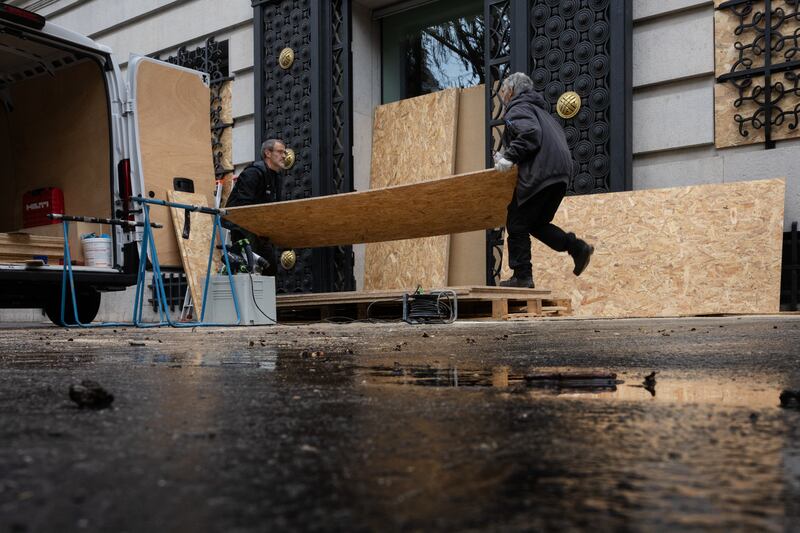
The city of Paris, however, was unconvinced. The Louvre and Musée d’Orsay announced they would shut their doors. Up and down the main shopping streets, shops could be seen covering their glass with chipboard.
[ Macron tightens curbs on protests and accuses far left of ‘seditious acts’Opens in new window ]


