

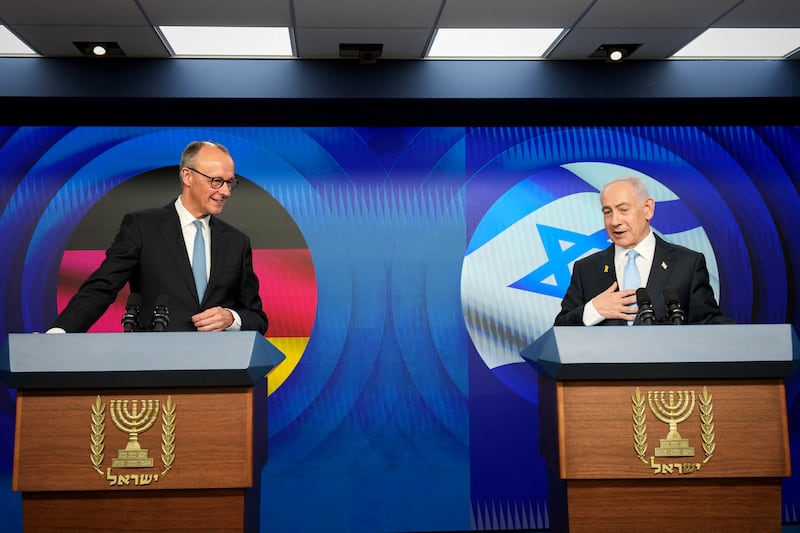
When chancellor Friedrich Merz made his inaugural visit to Israel on Sunday, he had no invitation in his pocket for its prime minister, Binyamin Netanyahu, to visit Germany.
Instead, realpolitik has quashed the jubilation of an election night phone call last February, when Merz said he promised Netanyahu “that we would find ways and means for him to visit Germany and leave again without being arrested in Germany”.
Six months on, the Netanyahu arrest warrant from the International Criminal Court remains active – as is the chancellor’s ways-and-means committee.
Instead, Merz said in Jerusalem there was “no occasion to speak at the moment” about an invitation, insisting it is “not an issue for either of us”.
RM Block


“I will extend an invitation if time allows,” said Merz, a nod to next year’s elections in Israel.
For his part, Netanyahu praised Merz as someone for an “open and honest” conversation and urged the ICC to “get rid of these ridiculous charges” against him.
But in the last six months, even leading CDU backers of Israel are quietly dropping arguments and language that, for two years, dominated official German discourse on Israel, the Netanyahu government and its response to the Hamas-led attacks of October 7 2023.
Last month, for instance, Merz discarded the term “Staatsräson”, or reason of state, saying it was “never spelt out in all its consequences”.
Instead of spelling out the consequences – such as critics’ claims that their criticism of Israeli politicians was conflated with anti-Semitism – Merz has found a new term.
In several appearances, Merz described Israel’s continued existence as part of Germany’s “Wesenskern” or core of Germany’s being.
This new label for the bilateral relationship, he added, meant criticism of Israel’s government was not just “possible but sometimes even necessary”.
“But criticism of the Israeli government cannot be used as an excuse for anti-Semitism,” he added. “Above all not in Germany, that is also part of our historical responsibility.”
After taking office in May, Merz halted some arms deliveries to Israel, criticising the civilian cost of the Gaza military strategy.
While this halt sparked criticism inside his own party, the restart of arms exports earlier this month infuriated Israel critics and leftist opposition political parties.
Another bone of contention: last week’s activation in Germany of a €3.6 billion Israeli-built Arrow air defence system for medium-range ballistic missiles.
Back in Jerusalem, Merz said Israel’s long war in Gaza had created “a certain dilemma” for Germany: torn between its sense of responsibility to Israel and its commitment to international law and universal human rights.
That remark, in turn, prompted annoyance among critics of Israel in Germany, many of whom say they have faced the weaponisation of anti-Semitism in the last two years.
Berlin-based Jewish artist and activist Adam Broomberg, who grew up in South Africa and supports Israel boycotts, said it was inappropriate for Merz to make such a visit or speak of a “dilemma” over international law, which arose from the Nazi atrocities.
“It is very troubling to me that Merz is visiting a country that has broadly been accused of genocide and breaking numerous other instances of that law,” he said.
As Germany plots a way forward from its immediate post-October 7th stance, the country still faces a spike in documented anti-Semitism cases. Responding to that, federal cultural Minister of state Wolfram Weimer is preparing new laws to withdraw State funding for artists who express anti-Semitic views.
At a recent gathering of the Central Committee of Jews in Germany, the country’s leading Jewish organisation, even Weimer acknowledged the difficulty of finding an uncontested working definition of anti-Semitism.
[ The German arms giant capitalising on renewed fear of RussiaOpens in new window ]


