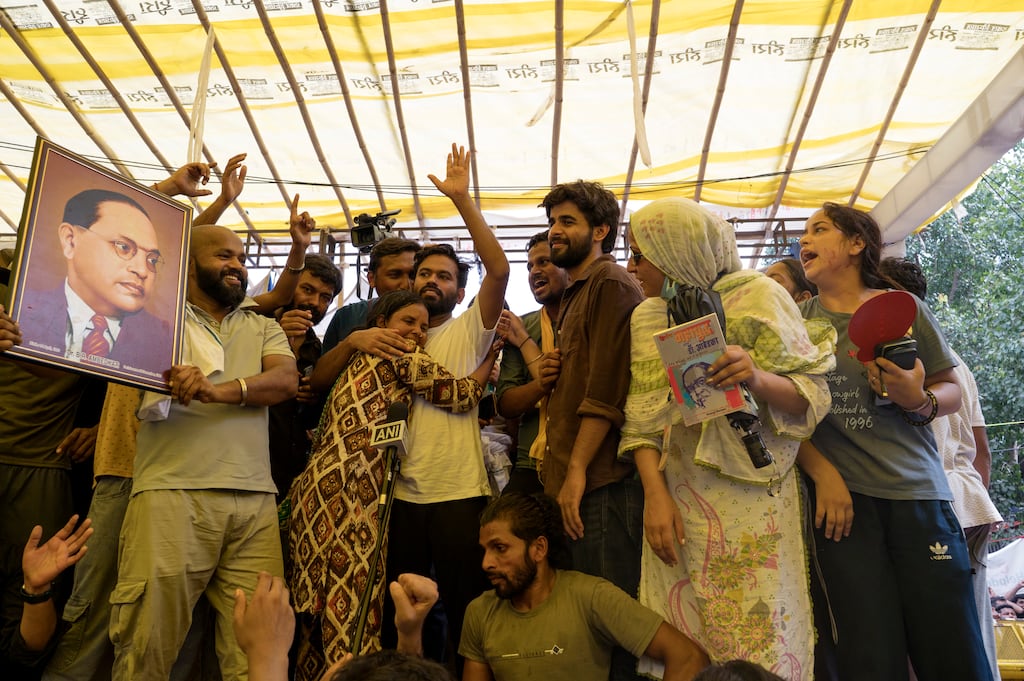


The success of a broadly-based youth movement in forcing India’s government into retreat is a welcome sign of the vitality of dissent within the world’s biggest democracy.
Cockroaches triumph over Modi
When Narendra Modi’s government introduces legislation today to toughen penalties for leaking examination papers, it will be an attempt to regain the initiative after last week’s climbdown to protesters. But during more than three weeks of demonstrations, the young people inspired by the satirically named Cockroach Janta Party (CJP) have broadened their focus beyond the exam scandal that started it.
The CJP ended its protest in New Delhi’s Jantar Mantar after the government gave in to all of its demands, including the resignation of education minister Dharmendra Pradhan and a guarantee that nobody would be prosecuted for taking part in the demonstrations. After weeks of ignoring, sneering at or demonising the young demonstrators, egged on by much of India’s print and broadcast media, Modi’s government was forced to negotiate with it.


The story began on May 3 when 2.2 million young Indians sat the NEET-UG, an entrance exam for just 137,000 places at medical, dental and veterinary schools. When it emerged a week later that 120 questions in the matched mock papers that had been circulating online before the test, the authorities cancelled the exam so that everyone had to sit it again on June 21.
The NEET-UG is held a few weeks after the school leaving exam, putting students under enormous pressure, with many parents stretching themselves financially to pay for extra tuition. Between the cancellation of the exam and the date of the resit, around 20 students took their own lives.
The scandal was only the latest in a succession of failures by India’s education authorities, including frequent exam paper leaks and inadequate oversight of substandard third-level colleges. And it compounded the frustration felt by millions of young Indians who face formidable hurdles to earn a university degree, only to emerge into a job market with shrinking opportunities.
When chief justice Surya Kant compared young people who criticised the system to cockroaches, Abhijeet Dipke, an Indian student living in Boston, posted on Instagram: “What if all cockroaches come together?” Millions responded and Dipke founded the Cockroach Janta Party (CJP) a satirical echo of Modi’s Bharatiya Janata Party (BJP) which has governed India for the past 12 years.
Dipke returned to India on June 6 to organise protests across the country but attendance was modest at first as much of the media declined to report on the demonstrations. The turning point came on June 28 when Sonam Wangchuk, an engineer, climate activist and education reformer, joined the protest at Jantar Mantar and began an indefinite hunger strike.
As the protests gained momentum, police moved in on July 18 and forcibly transferred Wangchuk to hospital in what his wife described as illegal detention. Two days later, tens of thousands of people defied a ban to march on parliament, using Bluetooth mesh messaging apps to overcome police jamming of mobile phone networks.
Baton charges injured more than 150 protesters and the CJP claimed that police also used pellet guns but that evening, the authorities held talks with representatives of the demonstrators. On July 24, Wangchuk ended his hunger strike after he received written assurances from the government and the following day, Pradhan resigned as education minister.
The CJP called on demonstrators to go home, declaring that the government had conceded all their demands, including financial compensation for the families of students who had died by suicide after the exam fiasco. It was a remarkable victory by a movement that had no leaders and drew support from every part of Indian society, regardless of class, caste, religion, gender or ethnic origin.
There are more than 753 million Indians under 30 and more than 371 million between 15 and 30, with 45 million students enrolling in higher education each year, almost a third more than a decade ago. But as one young protester told India Today, the frustration of this generation goes far beyond the issue of education.
“Nothing works. The air you breathe is poison. Exams don’t happen. When they do, results take years. There are no jobs. No one listens. And when you speak, they unleash the police. Are we criminals?” she said.
Over the past 12 years, Modi has exploited religious, ethnic and regional differences to convert narrow electoral victories into expansive mandates. He has advanced a unitary, majoritarian agenda at odds with India’s traditional democratic consensus behind secularism and federalism, assisted by a passive judiciary and much of the media.
The movement that triumphed last week, broadly based, horizontally structured and non-sectarian, is part of an older Indian tradition of non-violent struggle. Its success offers hope for the rejuvenation of the world’s largest democracy.
Please let me know what you think and send your comments, thoughts or suggestions for topics you would like to see covered to denis.globalbriefing@irishtimes.com